
Last updated July 11, 2026
Chimney Cleaning & Sweep Maintenance Checklist for New Haven Homeowners
Most chimney checklists online tell you to “look for soot” and “check the damper.” That’s the equivalent of checking your oil by looking at the hood — the real maintenance questions are more specific, and answering them wrong costs New Haven homeowners thousands in avoidable liner damage every year. After 11 years of climbing roofs across Fair Haven, East Rock, and Westville, we’ve seen what happens when a “simple sweep” gets delayed past the point where a liner could have been saved. This guide gives you a diagnostic framework: a way to determine whether your chimney needs a sweep, an inspection, a repair, or nothing at all.
Quick Answer
A proper chimney maintenance checklist for New Haven homeowners includes three layers: a pre-season visual inspection you can perform from the firebox, a mid-season burn-habit assessment that determines your actual creosote buildup rate, and post-storm checks after freeze-thaw events or nor’easters that accelerate mortar and crown damage. Document everything — a maintenance log protects your insurance coverage and proves due diligence at sale time.
Table of Contents
- Pre-Season Visual Inspection: What You Can Safely Check From the Firebox
- Freeze-Thaw Damage: Reading Your Chimney’s Exterior in New Haven Winters
- Burn Habit Tracking: How Your Fire Behavior Changes Your Sweep Schedule
- Post-Storm Inspection Triggers: After Nor’easters and Ice Events
- Building a Maintenance Log That Protects Your Investment
- The Safety Caveat: What Requires a Camera and a Trained Eye
- Common Mistakes to Avoid
- When to Call a Professional
- Frequently Asked Questions
Pre-Season Visual Inspection: What You Can Safely Check From the Firebox
Every October, we field calls from New Haven homeowners who lit their first fire without looking first. Some get lucky. Others find smoke backing up into the living room because a summer’s worth of debris — or a bird’s nest — has blocked the flue. Here’s what you can assess safely without climbing a ladder or dismantling anything.
Step 1: The Firebox and Damper Check
- Open the damper fully. It should move smoothly without grinding or catching. If it’s rusted in place, that’s your first sign that moisture has been entering the system.
- Shine a flashlight up the flue. You’re looking for visible obstructions — bird nests, squirrel debris, or collapsed liner sections. Do not attempt to remove blockages yourself; this is where carbon monoxide risk begins.
- Check the firebox walls for cracked or missing firebrick. Heat expands cracks, and a compromised firebox can transfer heat to combustible framing.
- Look for white or gray powdery deposits (efflorescence) on the firebox walls. This indicates moisture migration through the masonry — a problem that worsens dramatically through New Haven’s freeze-thaw cycles.
Step 2: The Hearth and Surround Assessment
- Verify that hearth extension dimensions still meet clearance requirements — especially if you’ve changed flooring or added a rug.
- Check for discoloration or warping on the mantel or surround, which indicates past overheating events.
- Test smoke and CO detectors. This isn’t chimney-specific, but it’s non-negotiable.
In the Wooster Square and Downtown New Haven areas, we see a lot of converted fireplaces where homeowners aren’t sure whether they’re looking at a working fireplace or a decorative one. If you see a gas line but no damper, or a damper that’s been welded open, you likely have a vented gas log set — and that requires a different inspection protocol entirely.
Freeze-Thaw Damage: Reading Your Chimney’s Exterior in New Haven Winters
New Haven’s coastal climate delivers a brutal one-two punch: moisture from Long Island Sound humidity, followed by hard freezes that drive that moisture deeper into masonry with each cycle. Understanding what you’re seeing on your chimney’s exterior — and whether it’s cosmetic or structural — saves you from both panic and neglect.
Spalling Mortar: The Early Warning
Spalling is when the face of a brick or mortar joint flakes or pops off. In New Haven, we see this accelerate after winters with frequent freeze-thaw events, particularly in homes built before 1960 with softer, more porous brick. From the ground, look for:
- Granular debris at the chimney base — sand-like particles that have fallen from deteriorating mortar joints
- Brick faces that appear “sugared” or rough, losing their sharp edges
- Mortar joints recessed more than ½ inch from the brick face
Spalling mortar is repairable with tuckpointing, but only if caught before the brick itself loses structural integrity. Wait too long, and you’re looking at partial rebuild territory.
Efflorescence: The White Flag of Moisture
Those white crystalline streaks on your chimney’s exterior? That’s efflorescence — soluble salts left behind as water moves through masonry and evaporates. It’s not automatically dangerous, but in New Haven’s climate, it’s a reliable indicator that your chimney is absorbing water rather than shedding it. Common causes we diagnose:
- Failed or missing chimney cap allowing direct water entry
- Crown cracks that funnel water into the flue structure
- Deteriorated flashing where the chimney meets the roof plane
- Porous brick that was never properly sealed
We’ve replaced crowns in West Haven where efflorescence was the only visible symptom for three years — until the freeze-thaw cycle finally cracked the flue liner. Early intervention matters.
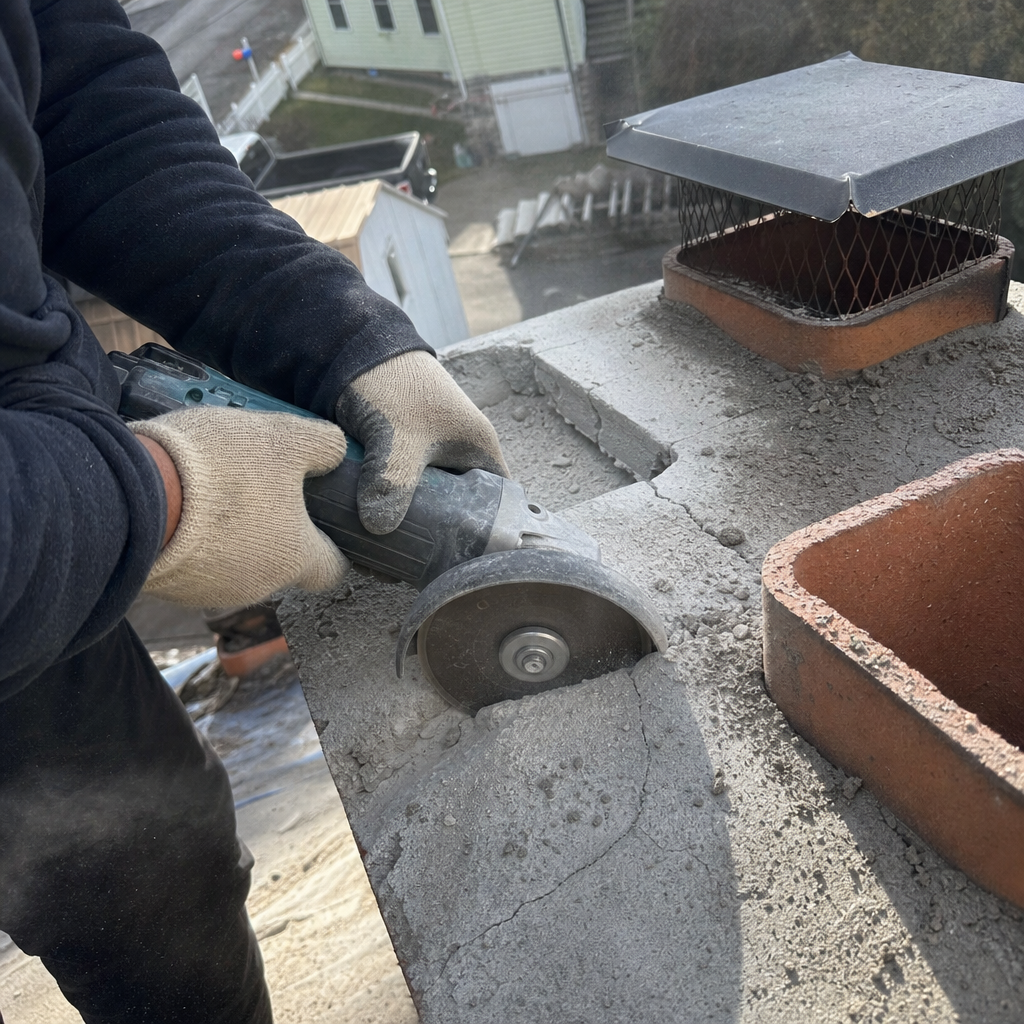
Crown Cracking: The Most Expensive Delay
The crown is the concrete or mortar cap that seals the chimney top. Hairline cracks are normal; cracks wider than 1/8 inch, or cracks that run to the edge, are not. In New Haven, we see crown failure accelerate when:
- The crown was poured without proper overhang (drip edge) to shed water away from the masonry
- Expansion joints between the flue tile and crown were omitted during construction
- The crown material was standard mortar mix rather than proper crown-specific concrete
For crown resurfacing, we use HeatShield or pour new crowns with proper formulation and reinforcement — not the quick-patch cement that some handymen apply.
Burn Habit Tracking: How Your Fire Behavior Changes Your Sweep Schedule
The National Fire Protection Association recommends annual inspection, but the actual sweep frequency depends on what you burn, how you burn it, and how often. Here’s how to track your habits and estimate your real maintenance needs.
The Wood Moisture Equation
Seasoned hardwood (oak, maple, hickory) at 15-20% moisture content burns efficiently and deposits minimal creosote. Green or damp wood — common when New Haven homeowners burn storm-fallen trees — can produce creosote buildup 3-4 times faster. We use a moisture meter on every service call; if you’re buying firewood, ask your supplier for the moisture reading or invest in a $25 pin meter.
Burn Frequency and Fire Type
| Fire Pattern | Estimated Creosote Rate | Suggested Sweep Interval |
|---|---|---|
| Weekend evening fires, seasoned hardwood | Standard | Annual |
| Daily heating fires, mixed wood types | 1.5-2x standard | Every 6-8 months |
| Smoldering overnight burns for heat retention | 3-4x standard | Every 3-4 months |
| Green wood, softwood (pine), or holiday fires | 2-3x standard | Mid-season inspection advised |
The “smoldering overnight” pattern is especially common in New Haven’s older homes with drafty windows — homeowners try to stretch a fire’s heat through the night. This low-oxygen, low-temperature burn produces the glazed creosote that’s hardest to remove and most prone to chimney fires.
What to Track in Your Log
- Date range of burning season
- Estimated number of fires per week
- Wood source and type (with moisture reading if available)
- Any smoke backup, unusual odors, or performance changes
- Visual observations from your pre-season check
Bring this log to your sweep appointment. It transforms a generic “when did you last clean it?” conversation into a diagnostic discussion about your actual system behavior.
Post-Storm Inspection Triggers: After Nor’easters and Ice Events
New Haven’s position on Long Island Sound means we catch the full force of coastal nor’easters — and the ice loading that comes with them. We’ve responded to calls after every major storm since 2015, and the damage patterns are consistent enough to predict.
Immediate Post-Storm Checks (Within 24-48 Hours)
- Visual roofline check from the ground: Look for shifted or missing chimney cap, visible liner damage, or new gaps between the chimney and roof structure. Do not climb on a wet or ice-loaded roof.
- Interior moisture check: Water stains on the ceiling near the chimney breast, or a damp odor from the firebox, indicate flashing or crown damage that allowed wind-driven rain entry.
- Debris assessment: Branches, leaves, or dislodged masonry at the chimney base suggest impact damage or structural movement.
- Damper function test: If water entered the flue, the damper may be rust-seized. Test before your next fire.
The Hidden Damage Pattern
Ice damming is common in New Haven’s older neighborhoods — East Rock, Wooster Square, Fair Haven — where insulation and ventilation are inconsistent. When ice dams form at the chimney-roof intersection, they force meltwater behind flashing that was previously secure. The damage often doesn’t manifest until the next thaw, when water finds its path of least resistance into the attic or down the flue.
After the March 2018 nor’easters, we documented crown damage in 23 West Haven homes that had shown no prior symptoms. The combination of saturated masonry and rapid temperature drop — from 50°F to single digits in 12 hours — caused expansion cracking that was invisible from the ground but clear on camera inspection.
When to Delay Your Next Fire
If you observe any of the following after a storm, do not light a fire until professional inspection:
- Visible gap or tilt in the chimney structure
- Water in the firebox or at the cleanout door
- Blocked flue (confirmed by flashlight check or smoke test)
- Carbon monoxide detector activation — even if brief
Building a Maintenance Log That Protects Your Investment
A maintenance log isn’t organizational overkill — it’s documentation that proves due diligence to your insurance carrier, your home inspector, and your buyer when you sell. We’ve seen New Haven home sales delayed because the seller had no record of chimney maintenance, forcing a last-minute inspection that revealed deferred repairs.
The Log Format We Recommend
| Entry Type | Information to Record | Supporting Documentation |
|---|---|---|
| Annual Inspection | Date, inspector name/company, scope (Level I, II, or III per NFPA 211), findings, recommendations | Written report with photos; keep digital and physical copies |
| Sweep/Cleaning | Date, technician name, creosote amount/condition, any damage noted, repairs performed | Invoice itemizing work; before/after photos if provided |
| Repairs or Modifications | Date, scope of work, materials used (brand/specification), warranty terms | Contract/invoice; warranty documentation; permit if required |
| Storm Events | Date, storm type, self-inspection findings, professional follow-up if any | Photos; correspondence with contractors; insurance claim numbers |
| Burn Season Log | Wood source, moisture content, fire frequency, any performance issues | Moisture meter readings; supplier receipts |
Retention and Access
Keep 10 years of records minimum — this covers most insurance lookback periods and the typical homeownership span. Store digital copies in cloud backup; physical copies in your home file. When we perform work for New Haven homeowners, we provide dated, photo-documented reports that are formatted for exactly this purpose.
For homes in historic districts — particularly around Yale’s campus and the designated New Haven historic areas — maintenance logs also support applications for exterior work permits, demonstrating that proposed repairs address documented deterioration rather than cosmetic preference.
The Safety Caveat: What Requires a Camera and a Trained Eye
Everything in this guide assumes you’re inspecting from the firebox or ground level. There are critical assessments that simply cannot be performed without proper equipment and training — and attempting them risks your safety and your chimney’s integrity.
Do not attempt:
- Roof-level inspection without proper fall protection and ladder safety training
- Flue liner assessment without a chimney camera — cracks and gaps are rarely visible from below
- Creosote removal beyond light brushing of the firebox — professional-grade brushes and rods are required for flue cleaning, and improper technique can damage liner tiles
- Any repair involving the combustion gas path — this includes liner work, damper modification, or connector pipe replacement
Carbon monoxide is odorless, colorless, and lethal. A compromised flue liner or blocked flue can vent combustion gases into living spaces without any visible warning. In 11 years, we’ve documented 14 New Haven homes with dangerous CO levels traced directly to chimney defects that passed casual visual inspection. A Level II inspection with camera evaluation is the only reliable way to assess flue condition.
George shows up on every job we perform — the person who quotes your inspection is the person who climbs your roof and runs your camera. That accountability matters when the stakes are this high.
Common Mistakes to Avoid
- Assuming no smoke means no problem. A chimney can vent adequately while concealing a cracked liner or significant creosote buildup. Smoke behavior is not a diagnostic tool — it’s a lagging indicator of failure.
- Using the “chimney sweep log” as a substitute for mechanical cleaning. These products can loosen light, flaky creosote but do nothing for glazed or third-degree buildup. We’ve found layers of hardened creosote behind a false sense of security in homes throughout New Haven’s East Shore and Annex neighborhoods.
- Ignoring the crown because “it’s just the top.” Crown failure is the single most common entry point for the moisture that destroys flue liners and spalls brick. A $400 crown repair prevented saves a $3,000 liner replacement.
- Hiring a general contractor for chimney-specific work. HVAC techs and handymen may understand heating systems or general construction, but chimney dynamics — draft physics, combustion chemistry, clearances to combustibles — require focused expertise. We’ve corrected work by well-meaning generalists that created immediate fire hazards.
- Skipping inspection after a home purchase. In New Haven’s competitive market, buyers often waive inspection contingencies. If you bought without a Level II chimney inspection, schedule one before your first burning season. We’ve found abandoned oil burner connectors, deteriorated terra cotta liners, and unlined brick flues in “move-in ready” homes.
- Burning treated lumber, pallets, or construction debris. The chemicals in pressure-treated wood and pallet markings produce corrosive deposits and toxic combustion byproducts. This isn’t a minor efficiency issue — it’s a liner destroyer and health hazard.
- Waiting for “the right time” to schedule. In New Haven, sweep demand spikes with the first cold snap in October. Book your pre-season inspection in August or September, or expect 2-3 week delays when you actually want to use your fireplace.
When to Call a Professional
Call for professional evaluation when: your pre-season check reveals any damage or obstruction; you’ve had a chimney fire (even a small one — the thermal shock cracks liners); you’re buying or selling a home; you’ve changed your heating appliance or fuel type; or you’ve experienced a major storm event. Any carbon monoxide detector activation demands immediate inspection — don’t wait for “convenient” scheduling.
Keystone Chimney Cleaning Greater New Haven offers free estimates in New Haven — call (888) 684-7419. George Nguyen personally evaluates every project, and from sweep to rebuild, we handle the full chimney lifecycle with professional-grade materials and no handoffs to subcontractor crews.
Frequently Asked Questions
A standard chimney sweep and Level I inspection in the New Haven market typically ranges from $200 to $350, depending on roof access difficulty, flue condition, and whether creosote removal requires specialized treatment for glazed buildup. Level II inspections with camera evaluation run $350 to $550 and are recommended for real estate transactions, post-storm assessment, or any system change. Call (888) 684-7419 for an exact quote — estimates are free, and we’ll specify whether your situation requires Level I or Level II scope before we schedule.
The NFPA 211 standard calls for annual inspection, with sweeping frequency determined by creosote accumulation — not calendar alone. In practice, New Haven homeowners burning seasoned hardwood 2-3 times weekly need annual sweeping; daily heating fires or softwood/green wood burning may require every 6 months. Your actual buildup rate depends on burn habits we detailed above. We recommend at minimum a pre-season inspection every September to assess whether sweeping is needed before you light your first fire.
A sweep removes combustible deposits (creosote, soot, debris) from the flue and firebox. An inspection evaluates the system’s condition, clearances, and safety — it may or may not include sweeping. In our 11 years, we’ve performed inspections that revealed no sweeping was needed, and sweeps that revealed inspection-critical damage. They’re complementary services, not interchangeable. Our Chimney Cleaning & Sweep in West Haven page details our sweep protocol; for repair-focused evaluation, see our Chimney Repair in West Haven services.
Light firebox debris removal and ash cleanup are safe homeowner tasks. Flue sweeping requires proper brushes, rods, and technique matched to your liner material and flue dimensions — incorrect tools can damage terra cotta tiles or fail to remove hazardous buildup. More critically, without camera inspection, you cannot assess liner condition or confirm complete cleaning. For the combustion gas path, we recommend professional service. The carbon monoxide risk of an undetected liner crack far exceeds any cost savings from DIY sweeping.
Active chimney fires produce loud cracking or popping, dense smoke, and a hot, intense odor — but many go undetected, burning slowly within the flue. After any suspected fire event, you may find: cracked or discolored flue tiles (visible only by camera), damaged chimney cap or exterior masonry from thermal expansion, or creosote flakes in the firebox or at the cleanout. Even “minor” chimney fires thermally shock liners and require professional inspection. Do not use the chimney until evaluated.
Structural repairs, liner replacements, and new chimney construction typically require permits through the City of New Haven Building Department, with inspection at rough and final stages. Routine sweeping and minor cap replacement generally do not. We coordinate permits for all qualifying work and schedule required inspections — one of the advantages of working with a specialist rather than a generalist who may leave permit compliance to the homeowner. Historic district properties may have additional review requirements; we’ve navigated these for properties throughout Downtown New Haven and the Yale area.
For stainless steel liners, localized damage sometimes permits partial repair or sectional replacement, but terra cotta liners with multiple cracks, spalling, or displacement typically require full replacement. The “repair versus replace” decision depends on liner material, damage pattern, and appliance compatibility — a $800 repair that fails in two years is more expensive than a $2,200 replacement that lasts 20. We use DuraFlex and Olympia Chimney stainless liners with proper sizing and insulation for New Haven’s heating loads, and we’ll show you camera evidence of why we recommend each approach.
Ask: whether the person quoting will also perform the work (accountability); what level of inspection is included and whether camera evaluation is standard; what materials and brands will be used for any repairs; whether permits and inspections are handled; and what documentation you’ll receive. 412 homeowners have trusted us with these answers, and we provide written, photo-documented reports for every service. For fireplace-specific services, see our Fireplace Services in West Haven page.
The Bottom Line
A chimney maintenance checklist is a decision tool, not a reminder list. The pre-season inspection tells you whether it’s safe to light your first fire. Burn-habit tracking prevents the overconfidence that leads to dangerous creosote accumulation. Post-storm checks catch freeze-thaw damage before it reaches your liner. And a documented maintenance log transforms routine service into asset protection — for your insurance, your safety, and your home’s resale value. In New Haven’s coastal climate, the homeowners who avoid emergency repairs are the ones who read their chimneys diagnostically, not just cosmetically.
Ready for your pre-season inspection? Keystone Chimney Cleaning Greater New Haven home — call (888) 684-7419 for a free estimate. George Nguyen will evaluate your system personally, and you’ll get a documented, photo-backed report that belongs in your maintenance log.
Written by George Nguyen, Owner & Lead Technician at Keystone Chimney Cleaning Greater New Haven, serving New Haven since 2015.