
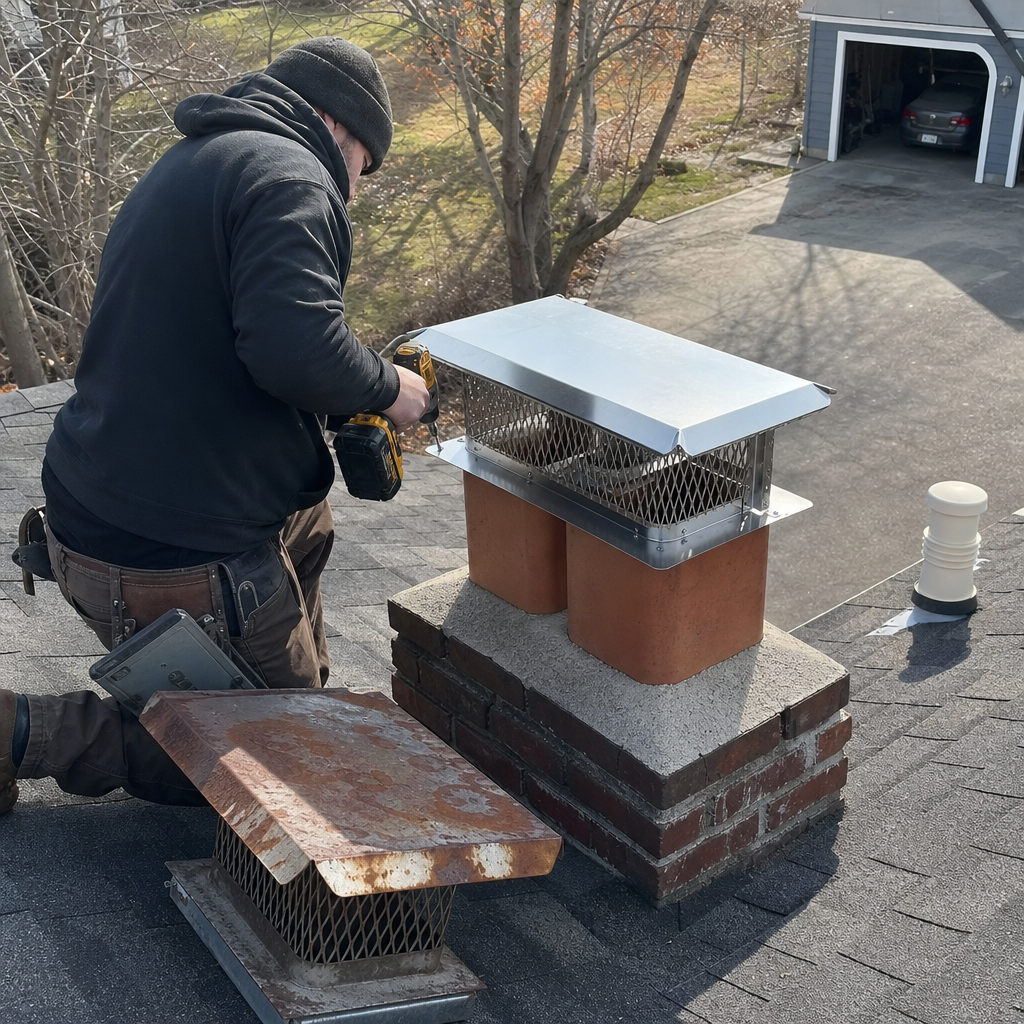
Chimney Crown Repair Cost in New Haven, CT: What You’ll Actually Pay in 2024
In New Haven, chimney crown repair cost typically runs $450 to $1,850 depending on whether you’re sealing early-stage cracks or rebuilding a failed crown from the brick up. Most of our customers fall in the $680–$1,200 range for a proper crown coat with crack repair and drip-edge detail. Call (888) 684-7419 for a free, on-roof estimate — George shows up on every job, so the person quoting your work is the person doing it.
We’ve learned the hard way that New Haven’s coastal position makes this a different repair than what you’d budget for in Hartford or Waterbury. Sitting right on Long Island Sound, this city racks up more freeze-thaw cycles each winter — every crossing of 32°F forces water in your crown cracks to expand and contract. By spring, a hairline fracture becomes a channel. That’s why we don’t quote crown work from photos, and why “patch it and hope” costs more in the long run than doing it right once.
Why New Haven Crown Failure Looks Different Than Inland Connecticut
Most chimney repair guides treat freeze-thaw damage as generic northern-climate wear. It isn’t. New Haven Harbor’s thermal buffering means temperatures hover right at the freezing point more often than they do twenty miles inland. In Westville and East Rock, we’ve pulled apart crowns where cracks radiated outward from the flue tile like spokes on a wheel — classic ice-wedge geometry you see less of in dryer, colder inland towns.
The housing stock compounds this. New Haven’s dense clusters of pre-1920 brick triple-deckers and converted multi-families — especially in Fair Haven, Dwight, and the Hill — often run two to four flues through a single original chimney stack sized for coal burning. Those flue tiles sit close together at the crown, creating thermal stress concentration points where cracks initiate. When one tenant’s flue runs cooler because of a blocked liner, adjacent flue tiles expand and contract at different rates. We’ve seen crowns fail preferentially between flue pairs in these shared stacks, a pattern you simply don’t encounter in single-family suburban construction.
Here’s what that means for your repair scope:
- Early intervention (hairline cracks, no spalling): Professional-grade crown coat with flexible crack filler — catches the problem before ice wedging opens structural gaps
- Moderate damage (visible cracking, minor brick edge spalling): Crown coat plus targeted crack repair with mesh reinforcement — still preserves the original crown mass
- Advanced failure (cracks >¼ inch, brick deterioration, water staining below): Full crown demolition and rebuild with proper slope, overhang, and drip edge — the only permanent fix
- Historic district considerations (East Rock, Wooster Square): Design-review timeline added if the chimney is visible from the street on a contributing structure — we flag this before quoting
That last point saves homeowners more than you’d think. We’ve had calls where another company started crown work in Wooster Square without checking whether the chimney was subject to preservation review, and the homeowner got a stop-work notice with half their crown removed. George grew up in Fair Haven and still lives ten minutes from the house he was raised in — he knows which blocks trigger extra steps and builds that into the timeline upfront.
What Separates a Temporary Patch From a Permanent Crown Repair
We get asked constantly whether a $200 hardware-store sealant job will “get through another winter.” Sometimes, honestly, it will. More often, in New Haven, it won’t. Here’s the difference:
Surface patching with hydraulic cement or silicone sealant bridges the crack visually but doesn’t address the crack geometry. It sits on top. When water vapor migrates through the crown’s porous concrete — and it will, because all concrete breathes — it hits the cold interface and freezes behind the patch. The patch pops off by February. We’ve scraped failed DIY patches off crowns in East Rock every spring for eleven years.
Proper crown repair starts with understanding why the crack opened. We grind out the crack to a V-profile, bridge it with flexible mesh if it’s structural, then apply a formulated crown coat — we use HeatShield and Copperfield products engineered for freeze-thaw exposure, not unbranded bagged mixes. The finished crown must extend 2.5 inches past the brick face with a drip edge underneath, and it must slope away from the flue collar at minimum ¾ inch per foot. Flat poured crowns, common in 1960s–1980s New Haven construction, hold standing water and fail predictably. We correct the slope when we rebuild.
The material specification matters for coastal exposure. Olympia Chimney and Famco components we specify for cap and flue collar integration are rated for salt-air corrosion cycles. Generic galvanized or uncoated steel flanges rust through in five to seven years on a New Haven roofline. We’ve replaced too many “cheap” crown assemblies that failed structurally because the metal underneath corroded.
Chimney Crown Repair Cost Breakdown for New Haven Homeowners
These ranges reflect what we’ve actually billed for crown work across New Haven neighborhoods in 2023–2024. Every job gets a written, itemized estimate before work begins — no open-ended hourly billing.
| Repair Type | Typical Cost Range | What’s Included |
|---|---|---|
| Early-stage crack seal with crown coat | $450 – $680 | Surface prep, V-grinding of cracks, flexible filler, two-part crown coat application, flue collar inspection |
| Moderate crack repair with mesh reinforcement | $680 – $1,100 | Crack excavation, structural mesh bridge, crown coat with reinforced base layer, drip edge verification, water-test documentation |
| Partial crown rebuild (up to 50% of surface) | $950 – $1,450 | Demolition of failed sections, form-and-pour repair with bonded interface, slope correction, overhang and drip edge restoration |
| Full crown rebuild with proper geometry | $1,250 – $1,850 | Complete removal, formwork, steel-reinforced pour, specified slope and overhang, integrated drip edge, flue collar seal with rated components |
| Historic district design-review coordination | $150 – $350 (add-on) | Documentation submission, preservation officer liaison, material specification for review — only when applicable |
Multi-flue stacks in triple-deckers add complexity. When flue tiles are clustered tightly, we sometimes need to build custom formwork or use pourable repair compounds rather than standard trowel-grade mixes. That can push a moderate repair toward the higher end of its range, but we price it specifically — no surprises.
Compare this to what happens when you defer repair. Water intrusion through a failed crown saturates the brick below, accelerates mortar joint failure, and can rot roof sheathing at the chimney penetration. We’ve opened up crown-neglected chimneys in Dwight where the repair cascade ran to $4,000–$6,000 including repointing, flashing replacement, and interior drywall repair. The crown work that would have prevented it was quoted at $780 two years prior.
How Do You Know If Your Crown Needs Repair or Full Replacement?
We look for three specific failure modes on every roof inspection:
Crack pattern geometry matters. Hairline cracks running parallel to the flue tile, less than 1/16 inch wide, with no brick spalling below — these are candidates for crown coat preservation. Cracks radiating outward from the flue in a star pattern, or any crack you can fit a dime into, indicate structural movement. Patching those is throwing money away.
Spalling depth on brick edges. If the brick faces beneath the crown overhang are flaking but the mortar joints are sound, the crown drip edge has probably failed and water is running back against the brick. That’s repairable with crown correction. If the spalling extends past the first few courses and mortar is powdering, water has been migrating for years — we need to talk about Chimney Cap & Crown work in context of broader masonry restoration.
The sound test. We tap the crown surface with a masonry hammer. A solid crown rings. A delaminated crown thuds — the internal concrete has separated from the top layer, usually from freeze-saturation cycles. That crown is coming off, one way or another, and it’s better controlled than catastrophic.
George does this assessment personally on every job. If he wouldn’t light a fire in it tonight, he’ll tell you exactly why before he leaves the driveway. That’s not a slogan — it’s how we’ve earned 412 reviews averaging 4.7 stars from homeowners who’ve learned the hard way that not every chimney company sends the person who actually knows what they’re looking at.
Why Material Choice Matters for Coastal New Haven Exposure
We’ve mentioned the brands we use — HeatShield, Copperfield, Olympia Chimney, Famco — not to name-drop, but because the specification sheet determines whether your repair lasts eight months or eight years.
HeatShield’s crown coat formulations include acrylic modifiers that remain flexible below 0°F. Standard Portland-based crown mixes become brittle at 20°F and crack on the first hard freeze. Given that New Haven sees temperature swings from 15°F to 45°F repeatedly in a normal January, flexibility isn’t a premium feature — it’s basic engineering.
For flue collar seals and cap integration, we specify DuraFlex flexible liner connections where the existing flue allows, because rigid connections transmit crown movement stress directly to the flue tile. In multi-flue stacks common to Fair Haven triple-deckers, that stress concentration is exactly where we see the radial cracking pattern.
Generic “chimney sealant” from a hardware store is typically a solvent-based acrylic or silicone formulated for vertical wall waterproofing, not horizontal crown exposure. It UV-degrades in two years on a south-facing New Haven roof. We’ve peeled it off in sheets. The products we use are specifically rated for horizontal concrete exposure, freeze-thaw cycling, and salt-air contact — because that’s the environment your crown lives in.
FAQs
Most chimney crown repairs in New Haven cost between $680 and $1,200 for a proper job with professional-grade materials, with simple crack sealing starting around $450 and full rebuilds running up to $1,850. The exact price depends on crack geometry, whether the crown slope and overhang need correction, and whether you’re in a historic district requiring design review. Call (888) 684-7419 for a free, on-roof estimate — we don’t quote crown work from photos.
Repair is cheaper in the short term but only makes sense if the crack pattern is early-stage and the crown geometry was correct to begin with — proper slope, adequate overhang, intact drip edge. In New Haven, we’ve found that crowns poured flat or without drip edges (common in 1970s–1990s construction) fail repeatedly even after professional repair because the underlying design traps water. In those cases, full replacement with correct geometry costs more upfront but eliminates the cycle of re-repair. We’ll tell you straight which category you’re in after inspection.
We can perform crown coating and moderate repairs when temperatures stay above 40°F for the 24-hour cure window, which in New Haven typically means scheduling between late March and mid-November for optimal results. Emergency temporary waterproofing is possible in colder months to stop active leaks, but we won’t perform permanent crown pours below 40°F because the concrete won’t achieve proper strength — and we’re not in the business of doing work twice. If your crown is actively leaking in January, we’ll install temporary protection and schedule the permanent repair for the first reliable weather window.
A properly executed crown coat with correct crack repair lasts 8–15 years in New Haven’s climate; a full rebuild with proper slope, overhang, and drip edge lasts 20–30 years or more. The difference is almost always in the original crown geometry, not the material quality. We’ve revisited crowns we rebuilt in 2014 that still test sound, and we’ve re-repaired competitor “repairs” from 2021 that failed because the underlying flat crown design was never corrected. Call (888) 684-7419 and we’ll show you exactly what your chimney has now — and what it’ll take to make it last.
What to Expect When You Call Keystone
George Nguyen personally answers most calls or returns them within two hours. He’ll ask about your chimney’s age, what you’ve observed (stains, pieces on the ground, active dripping), and whether you’re in a historic district. He schedules a roof-level inspection — not a driveway guess — and delivers a written estimate with the repair type, material specification, and timeline before he leaves. No subcontracting, no handoffs, no day-labor crew learning chimney work on your roof.
We’ve built this business over eleven years on the principle that homeowners who heat with wood or gas deserve to understand what they’re paying for — and to hold one named person accountable for delivering it. From sweep to rebuild, Keystone Chimney Cleaning Greater New Haven handles the full chimney lifecycle. If you’re seeing crown cracks, don’t wait for the next freeze-thaw cycle to widen them. Call (888) 684-7419 today for your free estimate.
Written by George Nguyen, Owner & Lead Technician at Keystone Chimney Cleaning Greater New Haven, serving New Haven, CT.