
How Often Should You Clean Your Chimney in New Haven, CT? For Most Wood-Burning Flues, Once a Year — But Pre-1920 Coal Conversions Often Need Twice
The standard answer is once per year for wood-burning chimneys and once per year with inspection for gas units, per NFPA 211. In New Haven’s triple-deckers and converted coal-era housing, that annual standard is the minimum, not the recommendation — oversized flues, shared stacks, and coastal moisture conditions mean many local systems accumulate creosote faster than the code’s baseline assumes. If you’re burning wood in a pre-1920 flue originally sized for coal, you’re likely looking at two professional sweeps per burning season, not one. Call (888) 684-7419 for a free flue assessment and written condition report.
Why the “Once a Year” Rule Doesn’t Fit Every New Haven Chimney
The NFPA 211 standard was written assuming three things: a properly sized flue for the appliance, correct fuel type, and functional venting geometry. Walk through Fair Haven, Dwight, or the Hill with us and you’ll find plenty of chimneys that fail all three assumptions simultaneously.
New Haven’s housing stock is among Connecticut’s oldest and densest. Those late-Victorian triple-deckers and early-20th-century brick rowhouses weren’t built for today’s heating. They were built for coal — a fuel that burned hotter, produced less creosote, and required flues sized completely differently from modern wood or gas inserts. When a landlord or prior owner converted to wood-burning without resizing the flue, three problems stack on top of each other:
- Oversized flue runs cooler. Hot flue gases escape quickly; cooler gases linger, condense, and deposit creosote on flue walls at 2–3x the rate of a properly matched system.
- Clay tile liners in coal flues weren’t designed for wood combustion acids. They crack, spall, and create gaps where creosote hides and heat escapes into framing.
- Shared chimney stacks in multi-family buildings compound the risk. One tenant’s flue can affect draft and pressure dynamics for neighbors’ flues in the same stack.
We’ve pulled a quarter-inch of glazed creosote from flues in Dwight triple-deckers where the owner was following the “once a year” rule religiously — but the flue was so oversized that a single cord of oak produced what a proper system would accumulate in three. The NFPA standard isn’t wrong. It’s just not written for your chimney if your chimney was built in 1910.
How Flue Size Directly Controls Creosote Buildup — And Why New Haven Homeowners Should Care
Here’s the physics we explain on every job: creosote forms when wood smoke cools below its condensation point before exiting the flue. A flue that’s too large for the appliance — common in coal-to-wood conversions — has more surface area and more volume, so the smoke spends more time cooling on its way up. The result isn’t just “a little more buildup.” It’s dramatically faster accumulation that can push a marginal system from safe to hazardous in a single burning season.
In a properly sized 6″ or 8″ round flue for a modern wood stove, we typically measure 1/8″ to 3/16″ of creosote after a full season of regular use. In an oversized rectangular coal flue — say, 8″×12″ or larger — serving the same heat output, we’ve measured 3/8″ to 1/2″ in the same period. That difference matters because creosote ignites at approximately 451°F, and a layer just 1/4″ thick can sustain a chimney fire hot enough to crack liners and ignite adjacent framing.
George Nguyen, our Owner & Lead Technician, grew up in Fair Haven and still lives ten minutes from the house he was raised in. He’s been cleaning chimneys across Greater New Haven for over eleven years, and he’s become the guy people call when another company tells them something alarming and they want a second opinion they can actually trust. He does the work himself on the majority of jobs; his crew knows he’ll pull the same inspections they do, so nothing gets glossed over. When he measures creosote depth, he photographs it, records the location, and puts it in your written report — not because it’s required, but because “if I wouldn’t light a fire in it tonight, I’ll tell you exactly why before I leave the driveway.”
For landlords with multiple units on a shared stack, this isn’t just a maintenance schedule question — it’s a liability question. One tenant’s flue with heavy creosote can preheat adjacent flues during a fire event. We inspect every flue in a shared stack separately, document each independently, and flag when one unit’s condition creates stack-wide risk.
Gas Fireplaces: Different Fuel, Different Schedule, Same Annual Inspection
Gas-burning appliances produce minimal creosote, but “cleaning” isn’t the only reason for annual chimney service. Gas flues still need yearly professional inspection for:
- Liner integrity. Condensation from efficient gas appliances corrodes liners from the inside out; a failed liner can leak carbon monoxide into wall cavities or living spaces.
- Debris and animal blockage. Birds, squirrels, and nesting materials don’t care what fuel you burn — a blocked gas flue vents exhaust into your home, not up the chimney.
- Moisture intrusion damage. New Haven’s coastal freeze-thaw cycling, with temperatures oscillating across 32°F more frequently than inland Connecticut cities, accelerates mortar joint spalling and brick face delamination on exposed chimney crowns. A gas flue’s liner can be compromised by exterior masonry damage that has nothing to do with combustion.
We use HeatShield resurfacing systems and DuraFlex liner products when gas flue liners need repair or replacement — professional-grade materials, not catalog substitutes. The inspection itself takes 30–45 minutes; the peace of mind comes from knowing someone actually looked, not just ran a brush through and called it done.
What Our Chimney Cleaning & Sweep Includes — And What the Written Report Gives You
Our Chimney Cleaning & Sweep service isn’t a brush-and-vacuum operation. For every appointment in New Haven, we:
- Inspect the firebox, damper, smoke chamber, and flue with a high-resolution camera system
- Measure and document creosote depth and location
- Check liner condition, mortar joints, and crown integrity
- Verify cap and spark arrestor function
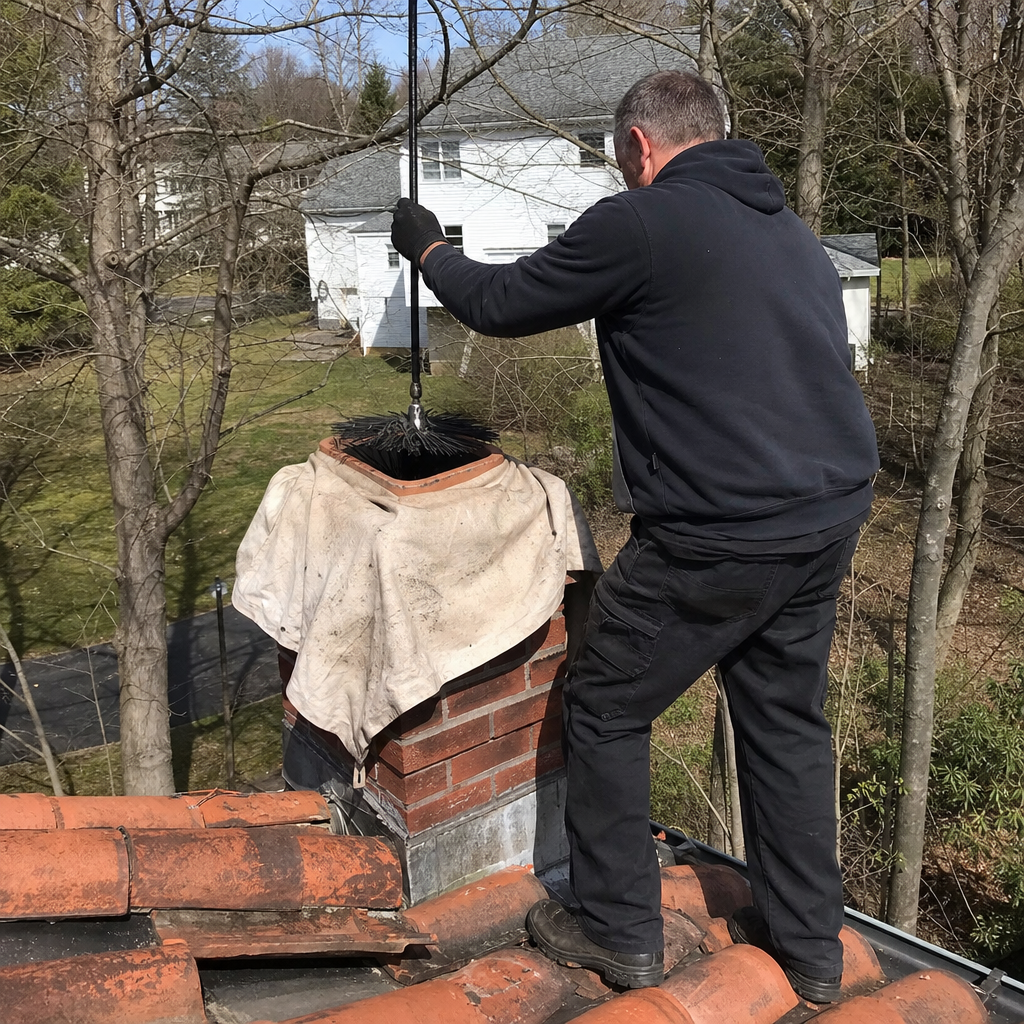
- Clean all accessible components with rotary brushes sized to your flue
- Provide a written condition report with photographs and recommendations
That report becomes your baseline. Next year’s sweep isn’t a guess about whether cleaning is needed — it’s a comparison against last year’s measurements. If creosote accumulation accelerated, we know your burn habits changed, your wood supply shifted, or your flue liner degraded. We can pinpoint the cause instead of treating every year the same.
For properties in East Rock or Wooster Square historic districts, we also flag when any visible repair work — repointing, crown rebuilding, or liner installation — may trigger design-review scrutiny under local historic preservation guidelines. Technicians who know to mention this before quoting save homeowners costly surprises. It’s a detail that rarely comes up in non-historic neighboring towns, but it’s standard in our New Haven assessments.
Key Takeaways: Your New Haven Chimney Cleaning Schedule
- Modern, properly sized wood-burning flue: Annual professional sweep and inspection
- Pre-1920 coal flue converted to wood: Twice per burning season (mid-season and end-of-season)
- Gas fireplace or insert: Annual inspection for liner, debris, and moisture damage; cleaning as needed
- Shared-stack multi-family: Every unit’s flue inspected annually, with stack-wide risk assessment
- After chimney fire or significant weather event: Immediate inspection regardless of schedule
FAQs
A standard sweep and inspection for a single wood-burning flue in New Haven typically runs $180–$280, with multi-flue or heavily creosoted systems ranging $280–$420 depending on access difficulty and buildup severity. Gas fireplace inspections start lower since less mechanical cleaning is required, but liner camera evaluation adds necessary time. We provide exact quotes before starting any work — call (888) 684-7419 for a free estimate.
No — deferred chimney maintenance almost always costs more. A $220 annual sweep prevents $2,000–$5,000 in liner replacement, masonry rebuild, or fire-damage restoration. We’ve rebuilt crowns and replaced liners in Wooster Square and Fair Haven homes where the owner skipped two years of sweeps; in every case, the accumulated creosote or moisture damage destroyed components that annual service would have preserved. Call (888) 684-7419 — estimates are free, and we’ll show you exactly what your flue looks like inside.
During peak season (September through January), we typically book 3–5 days out in New Haven proper, with faster availability for gas inspections or off-peak summer scheduling. We maintain emergency slots for suspected chimney fires or blocked flues with carbon monoxide concerns. For routine maintenance, scheduling your sweep in late summer secures your preferred date before the fall rush — call (888) 684-7419 to reserve.
Three quick indicators: rectangular or square flue tiles (round liners are modern), a flue dimension significantly larger than your appliance outlet, and construction date before 1930. In New Haven’s triple-deckers and rowhouses, we see this combination constantly — especially in Fair Haven, Dwight, and the Hill. George will measure your flue against your appliance specs during inspection and tell you definitively whether you’re running an oversized system. Call (888) 684-7419 to schedule that assessment.
When to Call Keystone Chimney Cleaning Greater New Haven
If you’re unsure whether your chimney fits the “once a year” standard or the “twice a season” reality, we’ll tell you straight — with a camera inside your flue, a measuring tape, and a written report you can keep. No vague recommendations, no scare tactics, just what we found and what it means for your next fire. Keystone Chimney Cleaning Greater New Haven offers no-pressure assessments across New Haven — call (888) 684-7419 for your free estimate.
Written by George Nguyen, Owner & Lead Technician at Keystone Chimney Cleaning Greater New Haven, serving New Haven, CT.