
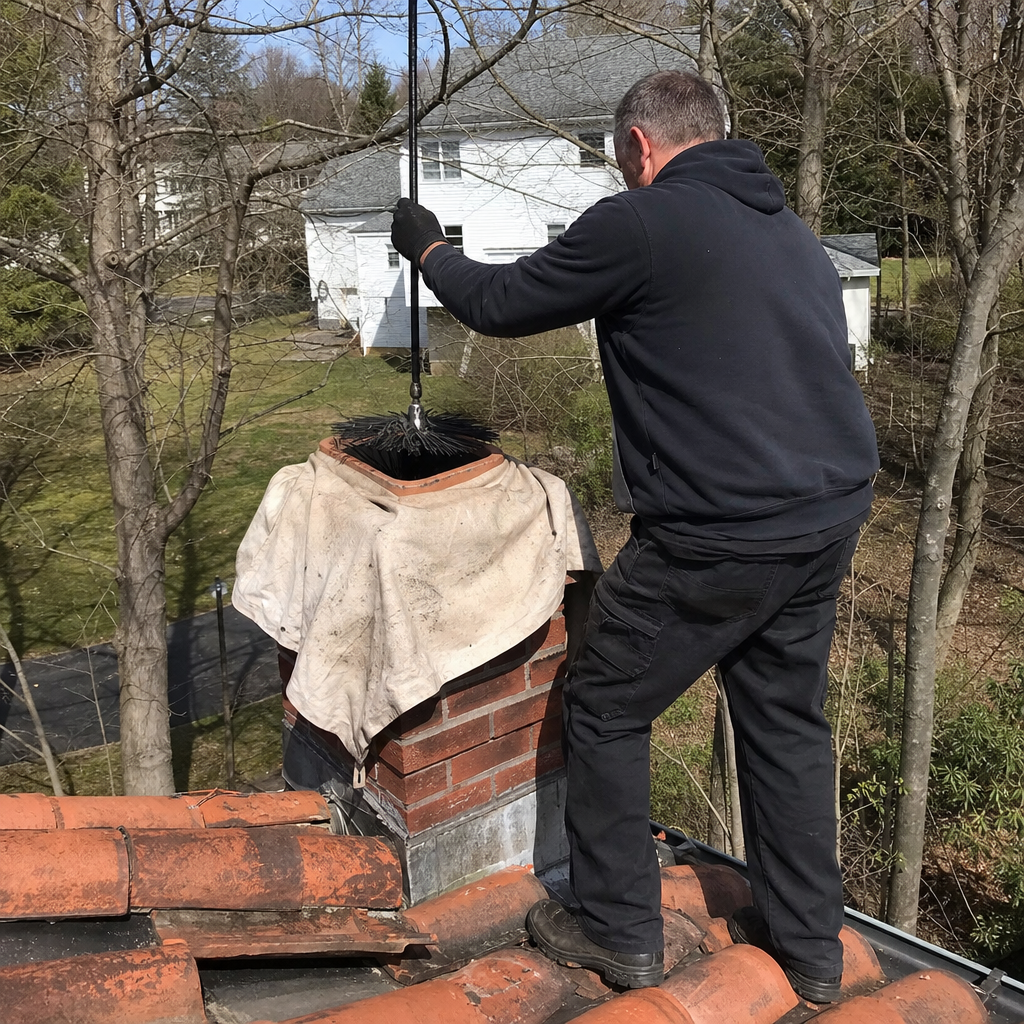
Signs Your Chimney Needs Cleaning in New Haven, CT — and Why the Most Dangerous Ones Hide in Plain Sight
The most reliable signs your chimney needs cleaning are smoke backing up into the room, a persistent campfire odor even when the fireplace isn’t in use, black or oily staining above the firebox, and visible creosote buildup thicker than 1/8 inch on the flue walls. In New Haven’s triple-decker housing stock, however, the deadliest warning signs often appear in a neighbor’s unit — or not at all — because shared chimney stacks can transfer carbon monoxide and creosote fire risk between flues without any visible symptom in the affected apartment. If you’re noticing any of these indicators in your Fair Haven, Dwight, or Hill neighborhood rental, call (888) 684-7419 for a same-day assessment.
The Signs Everyone Lists — and What They Actually Mean Inside Your Flue
Most chimney safety articles recycle the same checklist. We prefer to tell you what we’re actually seeing when we show up, because the symptom and the underlying problem are rarely the same thing.
Smoke backing up into the living space means your flue is operating at roughly 70% restriction or greater. That’s not “needs a sweep soon” — that’s “should not be used until inspected.” In eleven years across Greater New Haven, we’ve found this most often in clay-tile flues serving wood stoves that were retrofitted into coal-era chimneys originally sized for a much hotter, faster draft. The flue is too large for the appliance, smoke cools before it exits, and creosote plates the walls in thick, stage-two or stage-three layers that no homeowner brush can touch.
A campfire smell in July or August isn’t nostalgia — it’s stage-two creosote off-gassing as New Haven harbor humidity rises. That glazed, tar-like layer (we call it “black icicle” when it drips) becomes volatile between 60°F and 80°F ambient temperatures, which describes most summer days in the city. The smell means the deposit is active and releasing hydrocarbons. It also means your next fire could ignite it.
Black or oily staining above the firebox opening indicates smoke spillage on startup, almost always from a cold flue combined with restricted airflow. In New Haven’s dense neighborhoods, we see this constantly in rowhouses where the chimney runs up an interior wall and stays colder than exterior-stack designs. The fix isn’t just cleaning — it’s often adjusting the damper timing or, in older units, verifying the smoke chamber wasn’t parged with inferior mortar that’s now cracked and creating turbulence.
Here’s what we check when a homeowner reports these symptoms:
- Creosote stage and thickness at multiple flue heights (not just the reachable bottom)
- Clay-tile joint alignment — separation as small as 1/16 inch allows gas migration
- Smoke chamber condition, including parge coat integrity and shoulder cracks
- Liner fit and sizing against the appliance’s listed BTU output
- Crown and cap condition, since New Haven’s freeze-thaw cycling destroys mortar caps in 3-5 years
The Shared-Stack Problem: Why Your Neighbor’s Neglect Becomes Your Hazard
New Haven’s late-Victorian and early-20th-century triple-deckers — concentrated in Fair Haven, Dwight, and the Hill — commonly share a single original brick chimney stack with two to four separate flues serving different units. This isn’t a footnote. It’s the defining hazard of urban chimney maintenance in this market, and it’s why we treat multi-flue inspections as a separate service category from standard single-family sweeps.
Here’s the mechanism most competitors don’t explain: flues in a shared stack are separated by wythes of brick typically 4 inches thick, often degraded by a century of coal soot and modern moisture intrusion. When one tenant’s flue is heavily caked with stage-three creosote and ignites — a 2,000°F event that lasts 15-30 seconds — the thermal shock can crack the separating brickwork. Gases, including carbon monoxide, then migrate through the stack into adjacent flues. The tenant above or below may have no fireplace smoke, no odor, no visible staining. Their CO detector might not even trigger if the migration is intermittent and below the 70-ppm threshold.
We’ve responded to three such calls in the past four years where the originating flue hadn’t been swept in six-plus years, and the affected unit’s flue had been “cleaned” the season prior. The cleaning was irrelevant because the hazard traveled through masonry, not flue gas.
For landlords, this creates legal exposure that a standard sweep receipt doesn’t cover. Our Chimney Cleaning & Sweep service includes written documentation of creosote stage, liner condition, and stack integrity — a defensible record if a tenant or insurer ever asks when the chimney was last inspected and what was actually found.
The False-Negative Problem: Gas Fireplaces and Hidden Flue Damage
Gas fireplace flues accumulate almost no visible creosote. That’s the selling point — and the danger. Homeowners with gas inserts often skip inspection for years because “nothing burns in there.” What actually happens is subtler and, in some ways, worse.
Combustion byproducts from natural gas include water vapor and trace sulfur compounds. In New Haven’s coastal climate, that moisture condenses against cold clay tile, especially in shoulder seasons when the flue temperature hovers near dew point. Over seasons, this produces sulfuric acid attack on mortar joints, tile spalling, and — most critically — liner joint separation that allows CO into wall cavities.
A gas fireplace can operate perfectly while its flue silently fails. The signs you’d notice — headache, nausea, fatigue — are also signs of a hundred other things. By the time a CO detector sounds, the flue has been compromised for multiple heating seasons.
This is why we recommend Level 2 camera inspection for any gas fireplace in a pre-1960 New Haven home, regardless of visible symptoms. The camera reveals what no symptom can: liner joint separation, shoulder cracks at flue offsets, mortar washout inside the smoke chamber, and — in Fair Haven rowhouses especially — the telltale white efflorescence that indicates chronic moisture intrusion behind the facing.
What a Professional Inspection Actually Finds — and Documents
Our inspection protocol follows NFPA 211 standards, but the execution is specific to what we encounter in this housing stock. George shows up on every job, runs the camera himself, and dictates notes into a voice recorder that become your written report within 24 hours.
A typical Level 2 inspection in a New Haven triple-decker covers:
| Component | What We Document | Common Findings in Local Housing Stock |
|---|---|---|
| Flue liner | Material, diameter, condition, joint alignment | Clay tile with separated joints; unlined coal-era flues; improper sizing for wood/gas retrofit |
| Smoke chamber | Parge coat condition, shoulder cracks, dimension | Corbelled brick with no parge; 1970s-era parging now delaminated |
| Crown/cap | Material, cracks, overhang, drip edge | Portland cement crowns cracked from freeze-thaw; no cap or incorrect cap allowing direct rain entry |
| Creosote deposit | Stage (1-3), thickness, location | Stage 2-3 glazed deposits in wood stoves; stage 1 flaky deposits in fireplaces |
| Adjacent flues (multi-unit stacks) | Visual assessment of separation integrity | Degraded wythes; evidence of past thermal event; mortar voids |
The report includes photographs from the camera run, creosote stage classification, and explicit recommendations with priority ranking. For rental properties, we note whether the condition creates immediate habitability concerns or documented liability exposure.
When Repair Follows Cleaning: Materials and Methods We Use
Not every flue that needs cleaning can be safely cleaned. Stage-three glazed creosote, in particular, often indicates that the underlying liner is damaged or that the flue is improperly sized for the appliance. In these cases, we quote repair before we quote sweep — because cleaning a compromised flue without addressing the cause is malpractice.
For liner rebuilds, we specify DuraFlex or Olympia Chimney stainless steel relining systems, sized precisely to the appliance’s venting requirements. For crown reconstruction, we use Gelco pre-formed concrete crowns or custom-poured assemblies with integrated drip edges and proper overhang. Where the smoke chamber requires resurfacing, HeatShield cerfractory foam provides a UL-listed repair that restores smooth venting geometry without rebuilding the firebox.
These aren’t catalog substitutes. They’re the materials we specify because we’ve seen what happens when corners get cut — and because George does the work himself, he’s accountable for every joint and every pour.
Historic District Considerations: East Rock and Wooster Square
In East Rock and Wooster Square historic districts, any repointing or liner work on a chimney visible from the street can trigger design-review scrutiny under local historic preservation guidelines. We’ve learned to flag this before quoting repair work, because a $2,800 liner job that requires a $400 historic review application and six-week delay is a different proposition than one that doesn’t.
This doesn’t affect cleaning — sweep and inspection require no permit — but it matters when inspection reveals crown failure, mortar joint spalling, or liner damage that needs open repair. We note the district status in our initial assessment and advise accordingly. Technicians who don’t know to ask this question cost homeowners costly surprises, or worse, perform unpermitted work that complicates future sale or insurance claims.
FAQs
An affordable chimney cleaning and sweep in New Haven, CT with Level 1 inspection for a single fireplace typically runs $225–$325, while multi-flue stacks in triple-decker properties range $375–$550 depending on access difficulty and creosote stage. Level 2 camera inspection adds $150–$250. Call (888) 684-7419 for an exact quote — estimates are free, and we’ll tell you before we schedule whether your setup needs Level 1 or Level 2 protocol.
Homeowner brushes can remove loose stage-one creosote from the bottom few feet of a straight flue, but they cannot address glazed stage-two or stage-three deposits, inspect liner joints, or evaluate shared-stack integrity. In New Haven’s housing stock — with its unlined coal-era flues, multi-unit stacks, and frequent improper appliance retrofits — DIY cleaning creates false confidence and documented liability exposure. We recommend professional inspection at minimum, and we don’t perform sweeps without inspection because the visible creosote is rarely the actual problem.
NFPA 211 recommends annual inspection for all chimneys, with cleaning frequency determined by creosote accumulation rather than calendar. In practice, New Haven wood-burning fireplaces used as primary heat sources need sweeping every 1–2 cords of seasoned hardwood; gas fireplaces need Level 2 inspection every 2–3 years regardless of visible condition. The harbor climate’s moisture intrusion accelerates liner degradation, so we inspect more frequently than dry-climate standards would suggest. If I wouldn’t light a fire in it tonight, I’ll tell you exactly why before I leave the driveway.
Resurfacing with HeatShield or similar cerfractory products runs $1,800–$3,200 for a typical fireplace flue, while stainless steel relining with DuraFlex or Olympia Chimney systems ranges $2,800–$5,500 depending on height, diameter, and appliance configuration. Replacement is necessary when clay tile is extensively fractured, when the flue is unlined and oversized for the appliance, or when thermal damage has compromised the surrounding masonry. We quote both options when applicable and explain which conditions make resurfacing viable versus when replacement is the only safe choice. Call (888) 684-7419 to schedule an inspection that gives you real numbers for your specific flue.
What to Do If You’re Seeing — or Not Seeing — These Signs
The signs that make homeowners call are usually the late signs. The early signs require inspection to find, and in New Haven’s shared-stack housing, they may not appear in your unit at all. If you smell smoke when a neighbor lights up, if your CO detector has chirped intermittently without clear cause, or if you simply don’t know when your flue was last camera-inspected, that’s reason enough to schedule.
Keystone Chimney Cleaning Greater New Haven offers the best chimney cleaning and sweep in New Haven, CT, with no-pressure assessment throughout the city — from Fair Haven triple-deckers to East Rock historic properties to Wooster Square condos. George Nguyen personally runs every inspection, documents what he finds, and explains it without jargon or upsell. 412 homeowners have trusted us with this work, and we return to the same neighborhoods year after year because our reports hold up when they matter.
Call (888) 684-7419 for a free estimate, or visit our home page to learn more about our full chimney lifecycle services.
Written by George Nguyen, Owner & Lead Technician at Keystone Chimney Cleaning Greater New Haven, serving New Haven, CT.