
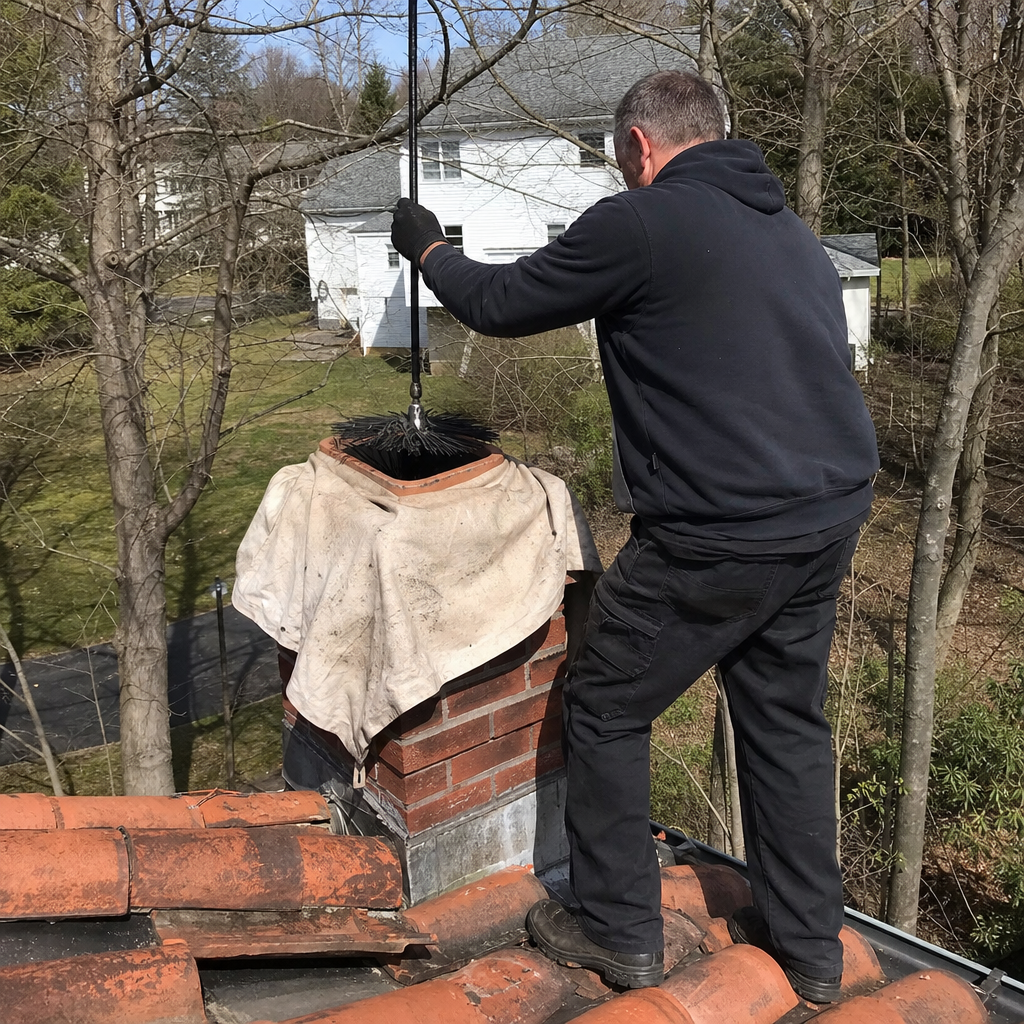
Creosote Buildup Is Condensed Wood Tar That Hardens Inside Your Flue — and in New Haven’s Oversized Coal-Era Chimneys, It Can Turn Rock-Hard in a Single Season
Creosote buildup is the residue left when wood smoke cools and condenses on chimney walls, forming a flammable deposit that ranges from dusty soot to glazed, rock-hard tar. In New Haven’s pre-1920 housing stock — where original coal-sized flues are routinely repurposed for wood stoves and fireplaces — that cooling happens faster and more severely than modern building codes ever anticipated. We’ve pulled Stage 3 glazed creosote from Fair Haven triple-deckers and East Rock converted singles after just one winter of what the homeowner thought was “clean” burning.
George Nguyen, our Owner & Lead Technician, grew up in Fair Haven and still lives ten minutes from the house he was raised in. He’s been inside enough New Haven chimneys over eleven years to know that creosote here doesn’t follow the tidy textbook progression most online explainers describe. Home
How Creosote Actually Forms: The Temperature Mechanism Competitors Gloss Over
Wood smoke exits a fire at roughly 300–600°F. For it to carry combustion byproducts safely out the flue, those gases need to stay above approximately 250°F — the dew point where volatile compounds begin condensing on chimney walls. Drop below that threshold, and you’re laying down creosote with every log.
Here’s what most New Haven homeowners don’t realize: their chimney was built for coal, not wood. Coal burns hotter and faster, requiring larger flue volumes to handle massive exhaust volumes. A typical New Haven triple-decker or pre-war rowhouse has an 8×12 or 10×10 inch flue — oversized by modern wood-burning standards. That extra volume means slower gas velocity, longer residence time, and chronic low flue temperatures. The smoke lingers, cools, and deposits creosote even when you’re burning properly seasoned hardwood.
The coastal climate compounds this. New Haven sits directly on Long Island Sound, and our winter temperature swings across the freezing threshold happen more frequently than inland Connecticut cities. Every freeze-thaw cycle pulls cold air down the flue when the fireplace isn’t running, pre-cooling the masonry before you even light the match. A chimney in Hartford starts warmer; yours doesn’t.
We’ve measured flue temperatures in Wooster Square and Dwight homes where the gas never climbed above 200°F at the smoke chamber — a full 50 degrees below safe condensation thresholds. Those homeowners were diligent about dry wood and hot fires. Their flue geometry betrayed them anyway.
The Three Stages of Creosote — and Why Each Demands a Different Removal Method
Generic explainers list three stages like they’re a neat ladder. In our experience across 412 New Haven-area jobs, we see them overlap, skip stages, or accelerate straight to the worst one depending on the flue. Here’s what each actually looks like when George pulls his inspection camera:
- Stage 1: Dusty, light-brown to black soot with a granular, almost coffee-ground texture. Brushes off easily with a standard wire chimney brush. This is what annual Chimney Cleaning & Sweep appointments are designed to catch.
- Stage 2: Crunchy, irregular flakes or porous “honeycomb” chunks — black or dark brown, with visible tar bonding. Requires rotary cleaning with a spinning cable and whipping heads to fracture and extract. A standard brush just polishes it.
- Stage 3: Glazed, shiny, enamel-hard coating — ranging from dark mahogany to jet black, with a surface like obsidian. This is condensed creosote that has repeatedly liquefied and resolidified, layer upon layer. It cannot be brushed or rotary-cleaned without damaging the liner. We treat it with a commercial-grade creosote modifier that chemically degrades the glaze over a controlled burn cycle, then follow with mechanical removal.
The critical distinction: Stage 3 is not a “deep cleaning” problem. It’s a structural threat that often forces liner replacement. We’ve seen it form in a single heating season in New Haven’s oversized flues — particularly where landlords in multi-family conversions burn construction scraps or pressure-treated lumber, accelerating deposition.
What Stage 3 Creosote Does in a Chimney Fire — and Why New Haven’s Triple-Deckers Can’t Absorb the Risk
Stage 3 glazed creosote burns differently than the fluffy stuff. When ignited, it sustains temperatures exceeding 2,000°F — hot enough to crack clay tile liner joints, spall brick faces, and compromise mortar in a single event. Standard chimney fires peak and fade; a Stage 3 fire persists, feeding on dense fuel bonded directly to the flue wall.
In New Haven’s dense neighborhoods — Fair Haven, the Hill, Dwight — triple-deckers commonly share a single brick chimney stack with two to four separate flues serving different units. A landlord’s neglect of one tenant’s flue doesn’t just risk that unit. It creates creosote and carbon-monoxide exposure for the entire stack. We’ve inspected stacks where one flue was pristine and another was a glazed hazard, separated by four inches of century-old brick. That’s not a cleaning issue; that’s a legal liability that demands multi-flue inspection protocols most generalist contractors don’t even know to propose.
After any Stage 3 removal, George runs a camera inspection top-to-bottom. The heat of formation that created the glaze often micro-fractures clay tile liner joints — damage invisible from the firebox. We build this into every Stage 3 job, not as an upsell, but because “If I wouldn’t light a fire in it tonight, I’ll tell you exactly why before I leave the driveway.” In East Rock and Wooster Square, where historic district design review can complicate exterior repairs, catching liner damage early also means flagging potential preservation compliance issues before quoting — saving homeowners from costly surprise approvals.
How Keystone Removes Creosote at Each Stage — Specific Tools, Not Generic Promises
Our approach changes with the deposit, which is why we camera-inspect before quoting every job:
Stage 1: Poly or wire brush sweep with HEPA-contained vacuum collection. We finish with a Gelco cap inspection — damaged or missing caps are the primary moisture entry point that accelerates future buildup.
Stage 2: Rotary cleaning with a spinning cable system and custom-fit whipping heads, sized to the flue. The tool fractures brittle Stage 2 deposits without the aggressive contact that damages older clay tile. We collect debris with a high-capacity vacuum and run a post-cleaning camera pass to confirm wall condition.
Stage 3: Chemical treatment with a professional-grade creosote modifier, followed by a controlled burn cycle that chemically degrades the glaze. After treatment, we mechanically remove the softened residue and — critically — camera-inspect for heat-induced liner damage. If the liner is compromised, we quote replacement using DuraFlex stainless steel or HeatShield resurfacing, depending on flue geometry and appliance type. We don’t patch and pray.
Materials matter. We install Olympia Chimney and Famco components where appropriate, and specify Copperfield hardware for custom cap and crown repairs. These aren’t catalog substitutes — they’re the brands we trust after eleven years of seeing what survives New Haven’s coastal weather cycles.
Common Local Scenarios: When New Haven Homes Build Creosote Faster Than Expected
The “Clean Burn” Wood Stove in an Oversized Flue
Homeowner in East Rock installs an EPA-certified stove, burns only seasoned oak, thinks they’re immune. The stove’s 6-inch collar connects to a 10×10 original flue. Gas velocity drops; creosote coats the upper flue where they can’t see it. We find Stage 2 honeycomb eighteen months later.
The Triple-Decker’s Neglected Third-Floor Flue
Landlord sweeps the first-floor unit annually; third-floor tenant never uses the fireplace, so it’s “not a problem.” Cold air settles in the unused flue, accelerating condensation on shared brickwork. We inspect the stack and find Stage 3 glaze in the dormant flue, with minor liner cracking already compromising the middle unit’s draft.
The Coastal Nor’easter Damage Spiral
Wind-driven rain from a February storm saturates the crown through a missing cap. Moisture combines with acidic creosote residue, accelerating mortar joint deterioration. By the following fall, the homeowner has both a creosote problem and a water-intrusion problem — each making the other worse. We address both, because cleaning a compromised chimney without fixing the entry path is temporary work.
What Homeowners Can Check — and What Requires George on the Roof
You can safely observe from the firebox: look for black, flaky deposits on the damper or smoke chamber walls, or a strong tar odor when you first open the damper. Excessive smoke spillage into the room when starting a fire often signals restricted draft from narrowing.
Do not attempt to scrape or probe deposits beyond arm’s reach. Do not use chemical logs marketed as “creosote removers” as a substitute for professional cleaning — they modify surface deposits but do not remove built-up material, and in glazed conditions they can create a false sense of security. Do not burn intentionally hot fires to “clean out” creosote; this is how chimney fires start.
Any suspected Stage 2 or 3 buildup, any performance change in your draft, or any multi-unit shared stack situation requires professional inspection. The tools for proper diagnosis — chimney cameras, draft gauges, combustion analyzers — aren’t homeowner equipment.
FAQs
A standard Affordable Chimney Cleaning & Sweep in New Haven, CT for Stage 1 typically runs $175–$275, while Stage 2 rotary cleaning ranges from $300–$450 depending on flue height and access. Stage 3 glazed creosote treatment starts around $500–$800 and may require follow-up visits or liner repair if heat damage is found. Call (888) 684-7419 for an exact quote on your specific flue — estimates are free, and George inspects before pricing.
Stage 1 soot can be partially reduced with proper burning practices, but complete removal requires professional tools and roof access for thorough cleaning. Stage 2 and 3 deposits demand specialized rotary or chemical treatment that is not safely performed without training — and without post-cleaning camera inspection, you cannot verify that the flue is actually clear. We don’t recommend DIY approaches for any deposit beyond light surface dust.
The National Fire Protection Association recommends annual inspection for all wood-burning systems, and in New Haven’s coal-converted flues we endorse that as a minimum — not a maximum. Homes burning more than three cords per winter, or those with oversized flues, often benefit from mid-season checks. Our 412 reviews reflect a customer base that takes this seriously; the ones who call after a scare usually wish they’d scheduled sooner.
Properly seasoned hardwood below 20% moisture content significantly reduces creosote formation, but it does not eliminate it — especially in New Haven’s oversized, coal-era flues that run chronically cool. Even “perfect” burning conditions deposit some residue, and one season of cold flue operation can accelerate Stage 3 glaze regardless of wood quality. Annual inspection remains essential.
When to Call Keystone Chimney Cleaning Greater New Haven
If you’re burning wood in a pre-1920 New Haven home — or managing a multi-unit property with a shared chimney stack — creosote dynamics here don’t match generic guidance written for modern construction. George Nguyen, our Owner & Lead Technician, has provided the Best Chimney Cleaning & Sweep in New Haven, CT across Fair Haven, Wooster Square, East Rock, Dwight, and the Hill for over eleven years. He handles the work personally, quotes from actual inspection findings, and won’t recommend services your flue doesn’t need.
If you’d rather have it looked at, Keystone Chimney Cleaning Greater New Haven offers a no-pressure assessment — call (888) 684-7419 to ask about Chimney Cleaning Cost in New Haven, CT.
Written by George Nguyen, Owner & Lead Technician at Keystone Chimney Cleaning Greater New Haven, serving New Haven, CT.