
Last updated July 11, 2026
Chimney Cleaning Permits, Codes & Inspections in CT: What You Need to Know
Here’s a scenario we see too often in New Haven: a homeowner hires a contractor for a chimney liner replacement, pays in full, and thinks nothing of it until they list their house for sale. The buyer’s home inspector asks for permit documentation. There isn’t any. The closing gets delayed, the buyer demands a price reduction, and suddenly that “affordable” liner job costs thousands more. In Connecticut, chimney work occupies a regulatory gray zone that most homeowners—and too many contractors—don’t fully understand. This guide breaks down exactly when permits are required, how NFPA 211 interacts with state and local codes, what inspections trigger disclosure obligations, and how to protect yourself from liability gaps that only surface when something goes wrong.
Quick Answer
Most routine chimney cleaning and sweeping in Connecticut does not require a permit, but any structural modification, liner replacement, firebox rebuild, or new appliance connection typically does. NFPA 211 sets the national safety standard that Connecticut’s State Building Code adopts by reference, while local building departments in New Haven and surrounding municipalities handle permitting and enforcement. Home sellers in Connecticut must disclose known chimney defects, and a Level 2 inspection creates documented evidence that can trigger repair obligations before closing.
Table of Contents
- Which Chimney Services in CT Require a Permit?
- How NFPA 211 Interacts with Connecticut’s State Building Code
- What a Level 2 Inspection Triggers for CT Home Sellers
- The Liability Gap of Unpermitted Chimney Work
- How to Request Permit Documentation from Your Contractor
- New Haven Code Enforcement: What to Expect
- Common Mistakes to Avoid
- When to Call a Professional
- Frequently Asked Questions
Which Chimney Services in CT Require a Permit?
The permit threshold in Connecticut isn’t always intuitive. Many homeowners assume that if a contractor shows up with brushes and rods, no paperwork is needed—and they’re usually right. But the line between maintenance and modification gets blurry fast, and crossing it without a permit creates legal exposure that sits dormant until a sale, insurance claim, or safety incident forces it into the open.
Permit-exempt maintenance work includes annual sweeping, creosote removal, basic cap cleaning, and standard visual inspections. These are classified as upkeep, not alteration, under Connecticut’s State Building Code. We’ve performed thousands of these maintenance sweeps across New Haven neighborhoods from East Rock to Westville without permit requirements.
Work that typically requires a permit includes:
- Chimney liner replacement or installation — This is the most commonly unpermitted work we encounter. Whether you’re installing a stainless steel DuraFlex liner or a cast-in-place system, you’re modifying the venting pathway of a combustion appliance. That’s an alteration under the code.
- Firebox rebuild or refractory panel replacement — Structural changes to the firebox affect clearances and heat management. New Haven’s building department treats this as regulated work.
- Crown reconstruction or significant masonry repair — Minor crown sealing is maintenance; rebuilding the crown’s structural form is alteration.
- New appliance connections — Connecting a wood stove, insert, or gas log set to an existing flue requires permit verification of proper sizing and clearance.
- Chimney cap installation on previously uncapped flues — Surprisingly, this can trigger review if the cap includes spark arrestor requirements or modifies draft characteristics in a way that affects appliance performance.
The critical distinction: does the work change the engineered performance of the chimney system? If yes, permit. If no, maintenance. When we quote liner work in New Haven, we explicitly state whether permitting is required and who handles the application. George shows up on every job, so there’s no confusion about who’s accountable for that documentation.
One practical note for New Haven homeowners: the city’s Building Department operates under the 2022 Connecticut State Building Code, which incorporates NFPA 211-2019 by reference. But permit interpretation varies by municipality. We’ve seen West Haven require permits for cap replacements that New Haven treats as maintenance. Always verify with your local building department if your contractor is vague on requirements.
How NFPA 211 Interacts with Connecticut’s State Building Code
NFPA 211, the Standard for Chimneys, Fireplaces, Vents, and Solid Fuel-Burning Appliances, isn’t a law by itself. It’s a consensus standard developed by the National Fire Protection Association that Connecticut—and nearly every other state—adopts into enforceable code through legislative reference. Understanding this relationship matters because it determines who enforces what, and what happens when there’s a gap between the standard’s language and local practice.
Connecticut’s approach works in layers:
- State level: The Connecticut State Building Code (CSBC) adopts NFPA 211 by reference, typically with Connecticut-specific amendments. The current cycle references NFPA 211-2019, though some municipalities lag in adoption.
- Municipal level: Local building departments enforce the CSBC within their jurisdictions. New Haven’s Building Department has authority to interpret ambiguous provisions, require additional documentation, or impose conditions beyond the base standard.
- Professional level: Certified chimney sweeps follow NFPA 211 inspection protocols (Level 1, 2, and 3) as industry best practice, even when not explicitly mandated by local ordinance.
Where this gets complicated for homeowners: NFPA 211 recommends annual inspection and cleaning as necessary, but Connecticut doesn’t universally mandate this by law for existing single-family homes. However, your insurance policy likely does. We’ve reviewed claims where carriers denied chimney fire coverage because the homeowner couldn’t produce inspection records, even though no municipal statute required them.
The climate factor in New Haven accelerates certain NFPA 211 concerns. Our freeze-thaw cycles, coastal humidity, and heavy nor’easter precipitation create conditions that the standard’s national language doesn’t explicitly address. In our 11 years focused on chimneys, we’ve found that flue liner deterioration happens faster in New Haven’s coastal zone than in inland Connecticut markets. NFPA 211’s clearance and material specifications assume generic conditions; local interpretation should account for accelerated masonry saturation and salt air exposure, particularly in neighborhoods near Long Island Sound.
When we specify materials for New Haven installations, we select professional-grade options designed for these conditions—Gelco stainless caps with proper overhang for water management, Olympia Chimney components rated for the temperature cycles we see, and Famco hardware that holds up to coastal corrosion. Generic catalog substitutes fail faster here, and NFPA 211’s minimum standards don’t capture that regional reality.
What a Level 2 Inspection Triggers for CT Home Sellers
A Level 2 chimney inspection is the most consequential—and most misunderstood—service in our industry. Under NFPA 211, it’s required at property transfer, after an operating malfunction or external event, or upon addition or removal of an appliance. In Connecticut’s active real estate market, this means Level 2 inspections happen constantly, yet many homeowners don’t grasp what the findings obligate them to disclose or repair.
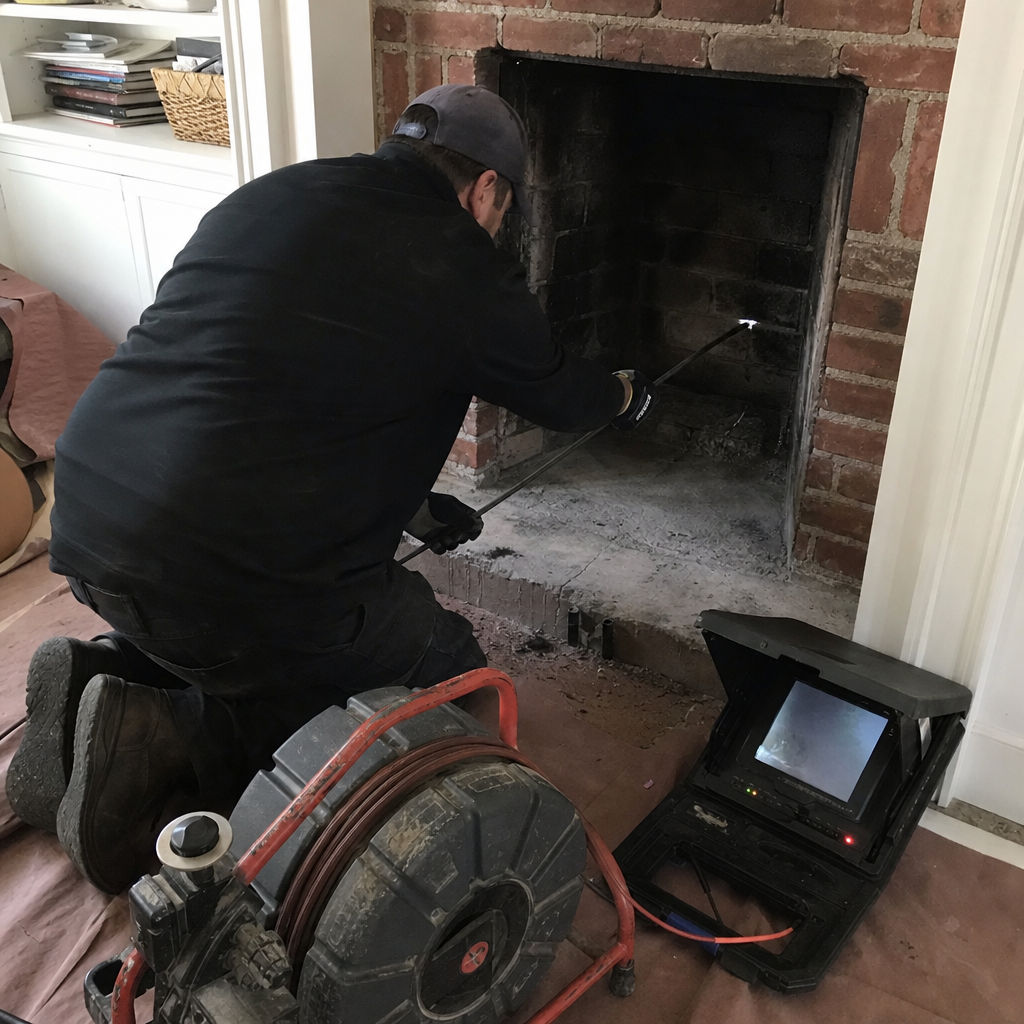
The inspection itself involves visual examination plus accessible portions of the chimney exterior and interior, including attics, crawl spaces, and basements. We use video scanning equipment to examine flue liners internally. In New Haven’s housing stock—heavy on 1920s colonials, mid-century ranches, and converted Victorians—this often reveals conditions that weren’t visible from the hearth.
Connecticut disclosure law (CGS § 47-36g, the Residential Property Condition Disclosure Act) requires sellers to disclose known defects in “heating, cooling, and ventilation systems.” A documented Level 2 finding of cracked flue tiles, deteriorated mortar joints, or improper clearances becomes “known” once it’s in writing. Failure to disclose can expose sellers to post-closing liability, even if the buyer waived inspection contingencies.
Here’s how this plays out in practice across New Haven neighborhoods:
- East Rock and Wooster Square: Older masonry chimneys with original terra cotta liners. Level 2 scans frequently reveal vertical cracking from thermal shock. Disclosure obligation: yes, if documented.
- Westville and Amity: Mid-century homes with factory-built metal chimneys. Level 2 inspection often finds improper clearances to combustibles from original installation or homeowner modifications. Disclosure obligation: yes.
- Downtown and Hill: Multi-family conversions with shared chimney systems. Level 2 inspection may reveal cross-contamination between units or improper appliance connections. Disclosure obligation: yes, and potentially more complex.
The practical trigger: once a Level 2 inspection documents a defect, the seller must either disclose it or repair it. There’s no “ignore it” option that doesn’t create legal exposure. We’ve been called into pre-listing situations where the homeowner hoped a quick sweep would suffice, only to learn that the video scan findings now require action. Getting ahead of this with a pre-listing Level 2 inspection—something we recommend for any New Haven seller with an active fireplace—is far less stressful than discovering problems during buyer due diligence.
The Liability Gap of Unpermitted Chimney Work
This is where homeowners get hurt financially, and it’s almost always preventable with basic documentation diligence.
When chimney work is performed without required permits, several liability gaps open:
- Insurance coverage denial: After a chimney fire, your carrier investigates. If they discover unpermitted liner work, they may deny the claim on the basis that the modification wasn’t code-compliant, regardless of whether the unpermitted work caused the fire. We’ve reviewed cases where the liner was unrelated to the ignition source, but the coverage denial stood because the policy required “all work performed in compliance with applicable building codes.”
- Contractor disappearance: Unpermitted work correlates strongly with contractors who won’t be found when problems surface. No permit means no record with the building department, no inspection verification, and often no written contract with proper business identification. We’ve been called to remediate “bargain” liner jobs where the original installer dissolved their LLC within months.
- Resale blockage: Connecticut buyers increasingly request permit documentation for any structural or mechanical work. Unpermitted liner installations are flagged by competent home inspectors, who know to check for permit stickers or recorded final inspections. The seller then faces a choice: obtain retroactive permitting (expensive, sometimes impossible), reduce sale price, or lose the buyer.
- Code enforcement action: While less common, New Haven’s Building Department can require removal or reinspection of unpermitted work, particularly if it’s reported by a neighbor, subsequent contractor, or insurance investigator. The cost of bringing unpermitted work into compliance typically exceeds original permitted installation.
Who’s responsible? The homeowner bears ultimate liability for unpermitted work on their property, even if the contractor misrepresented permit requirements. Connecticut courts have consistently held that property owners are responsible for ensuring compliance with building codes on their premises. The contractor may face separate penalties, but that doesn’t restore your insurance coverage or salvage your home sale.
Our protection advice, based on 11 years of seeing these situations: always request permit documentation before final payment, verify it with the issuing building department independently, and maintain records for the duration of your ownership. George shows up on every job, and we provide permit documentation as a standard deliverable—not an afterthought.
How to Request Permit Documentation from Your Contractor
Most homeowners don’t know what proper permit documentation looks like, which makes them easy marks for contractors who wave vague assurances. Here’s exactly what to request and verify:
Before work begins:
- Written permit application confirmation: The contractor should provide a copy of the submitted application or a permit number from the issuing municipality. In New Haven, permits are tracked through the city’s online portal; you can verify status independently.
- Scope-of-work alignment: The permit application description should match your contract. We’ve seen “chimney cap replacement” permitted when the actual work was full liner installation—a mismatch that voids the permit’s protective value.
- Contractor licensing verification: While Connecticut doesn’t license chimney sweeps at the state level, the permit applicant must be registered with the municipality. New Haven requires contractor registration for permit eligibility.
During work:
- Inspection scheduling confirmation: Permitted work requires municipal inspection at rough-in and/or final stages. The contractor should coordinate these and provide inspection date documentation.
- Field modification documentation: If conditions require changes to the permitted scope, change orders should be documented and permit amendments filed. We encounter this frequently in New Haven’s older housing stock, where concealed damage reveals itself only after work begins.
After completion:
- Final inspection approval: This is the critical document—a signed or stamped approval from the building inspector confirming code compliance. Without this, the permit is incomplete and offers no protection.
- As-built documentation: For liner installations, this should include liner sizing calculations, material specifications (we document DuraFlex or other professional-grade materials used), and appliance connection details.
- Warranty documentation tied to permitted work: Manufacturer warranties on materials like HeatShield or Copperfield components often require installation documentation; permit records support warranty claims.
Red flags that should halt payment: the contractor says “we don’t need permits for this” without explaining the specific exemption; permit documentation is promised “after final payment”; the permit is in a different name than the contracting entity; or inspection scheduling is “your responsibility.” Each of these indicates a contractor avoiding accountability.
New Haven Code Enforcement: What to Expect
New Haven’s Building Department operates with a practical, if occasionally backlogged, approach to chimney-related permits and inspections. Understanding their actual practices—not just the code book—helps set realistic expectations.
Permit turnaround: Routine chimney permits in New Haven typically process within 5-10 business days for straightforward applications. Liner replacements with no structural modification move faster than rebuilds requiring engineering review. During peak construction season (March through October), expect the longer end of that range.
Inspection scheduling: The department generally requires 24-48 hours notice for inspection requests. For chimney work, inspections focus on clearances, proper materials, and correct appliance connections. We’ve found New Haven inspectors knowledgeable about NFPA 211 requirements, particularly for solid fuel installations where fire safety is paramount.
Common inspection points in New Haven specifically:
- Proper clearance to combustibles in balloon-framed walls common in pre-1950s construction
- Chimney height relative to roof pitch and adjacent structures, particularly in dense neighborhoods like Downtown or the Hill where buildings are close
- Spark arrestor compliance in areas with wood-shingle roofs or heavy tree cover
- Proper termination height to avoid downdraft issues from coastal winds
Climate-specific enforcement: New Haven inspectors are attuned to moisture-related deterioration patterns we see near Long Island Sound. Crown inspections receive particular attention; inadequate overhang or improper slope that allows water penetration gets flagged. This aligns with our practice of specifying Gelco caps with adequate projection and proper drip edges for New Haven installations.
When enforcement escalates: Complaint-driven inspections happen when neighbors report visible unsafe conditions, or when insurance claims trigger building department review. Post-fire inspections are particularly rigorous; unpermitted work discovered during these investigations creates immediate compliance orders.
Our working relationship with New Haven’s Building Department, developed over 11 years of permitted installations, means we understand their expectations and can anticipate inspection concerns before they arise. That’s the difference between a contractor who files permits and one who knows how to get them closed successfully.
Common Mistakes to Avoid
- Assuming all chimney work is maintenance: Connecticut homeowners frequently categorize liner replacement as “cleaning” because it’s done by a sweep company. It’s not. Liner work alters the venting system and requires permit verification.
- Accepting verbal permit assurances: A contractor who says “I’ll take care of it” without showing you application documentation is asking for trust they haven’t earned. In New Haven’s competitive home services market, we’ve seen too many verbal promises evaporate.
- Skipping pre-listing inspection: Selling your New Haven home with an active fireplace? A buyer’s Level 2 inspection findings become your disclosure obligation. Getting ahead of this with your own inspection controls the timeline and negotiation position.
- Confusing sweep certification with permit authority: CSIA or NCSG certification indicates training in inspection and cleaning protocols; it doesn’t authorize permit filing. Only registered contractors can pull permits in New Haven.
- Ignoring manufacturer installation requirements: Professional-grade materials from brands like Olympia Chimney or Famco have specific installation parameters. Violating these voids warranties and may fail inspection, even if the bare minimum code is met.
- Neglecting permit record retention: Keep documentation for your entire ownership period plus statute of limitations. We’ve seen homeowners dig through decade-old files to prove compliance for insurance claims.
- Hiring based on price alone for permitted work: The lowest bid for liner installation often excludes permit costs, inspection coordination, and proper documentation. The true cost surfaces later, with interest.
When to Call a Professional
Certain situations demand immediate professional evaluation, not DIY assessment or delayed action. Call a qualified chimney specialist if you’re buying a home with an unknown chimney history, if you’ve experienced a chimney fire or significant weather event, if your heating appliance has changed or you’re considering a new installation, or if you’re preparing to list your property and need documentation of condition. Any visible cracking in the firebox, white efflorescence on exterior masonry, or draft problems that develop suddenly warrant prompt inspection.
Keystone Chimney Cleaning Greater New Haven offers free estimates in New Haven and surrounding communities—call (888) 684-7419. George Nguyen personally evaluates every project, and we provide clear documentation of whether permitting applies to your specific scope. From sweep to rebuild, one point of contact, no surprises.
Frequently Asked Questions
No. Routine chimney cleaning and sweeping is classified as maintenance, not alteration, under Connecticut’s State Building Code and does not require permitting in New Haven or any Connecticut municipality. Annual sweeping to remove creosote buildup, inspect for obstructions, and evaluate basic condition is exempt. Call (888) 684-7419 to schedule maintenance sweeping—estimates are free.
Stainless steel liner installation in the New Haven market typically ranges from $2,800 to $5,500 depending on flue diameter, height, number of appliance connections, and accessibility factors like roof pitch or interior chase configuration. Cast-in-place systems or specialized flex installations for offset flues run higher. Permitting and inspection fees, generally $150-$400 in New Haven, should be included in your contractor’s quote. Call (888) 684-7419 for an exact quote on your specific chimney—estimates are free.
A Level 1 inspection is a visual examination of readily accessible portions of the chimney exterior and interior without specialized equipment, appropriate for annual maintenance under unchanged conditions. A Level 2 inspection adds examination of accessible attics, crawl spaces, and basements plus video scanning of the flue interior, and is required at property transfer, after malfunction or external damage, or when adding or removing an appliance. In New Haven’s real estate market, Level 2 inspections are standard for transactions involving active fireplaces.
You can, but you’ll likely pay for it. Connecticut disclosure law requires reporting known defects, and competent buyers’ inspectors flag unpermitted modifications. Typical outcomes include price reductions of $3,000-$8,000, delayed closings while retroactive permitting is attempted, or lost buyers who won’t assume the liability. We’ve helped New Haven homeowners remediate unpermitted work pre-listing—it’s always cheaper than discovering problems during escrow.
The homeowner bears primary responsibility for ensuring code compliance on their property, even if a contractor performed the work. Your insurance carrier may deny coverage based on unpermitted modifications regardless of fire cause. The contractor may face separate enforcement action, but that doesn’t restore your coverage or compensate your losses. Always verify permit completion before final payment, and maintain records indefinitely.
New Haven’s Building Department offers online permit lookup through the city’s permitting portal. Request the permit number from your contractor, then verify independently that the application was submitted, inspections were scheduled and passed, and final approval was issued. The permit should list the correct scope of work, the contractor’s registered business name, and your property address. Any discrepancy warrants immediate clarification before payment.
The Bottom Line
Connecticut’s chimney regulatory environment rewards informed homeowners and penalizes those who trust blindly. The core principles: routine maintenance doesn’t require permits, but modifications do; NFPA 211 provides the safety baseline that Connecticut law enforces; Level 2 inspections create documented knowledge that triggers disclosure obligations; and unpermitted work exposes you to insurance denial, resale blockage, and personal liability that far exceeds any upfront savings. In New Haven’s older housing stock and active real estate market, these factors compound. Get permits in writing, verify them independently, keep records permanently, and work with contractors who treat documentation as standard practice—not an inconvenience.
Written by George Nguyen, Owner & Lead Technician at Keystone Chimney Cleaning Greater New Haven, serving New Haven since 2015.