
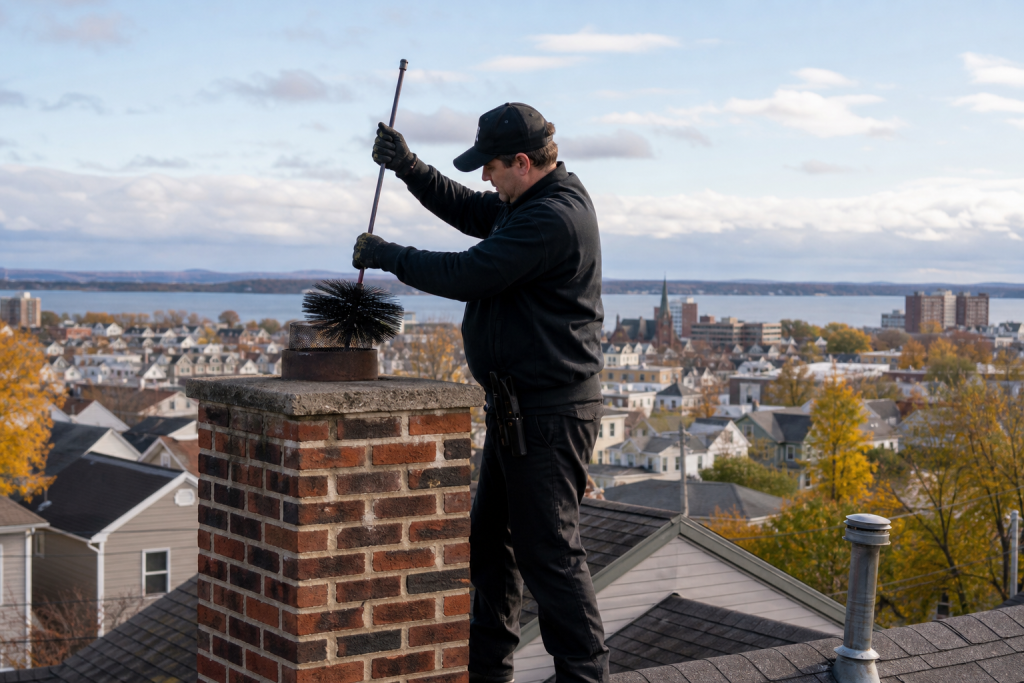
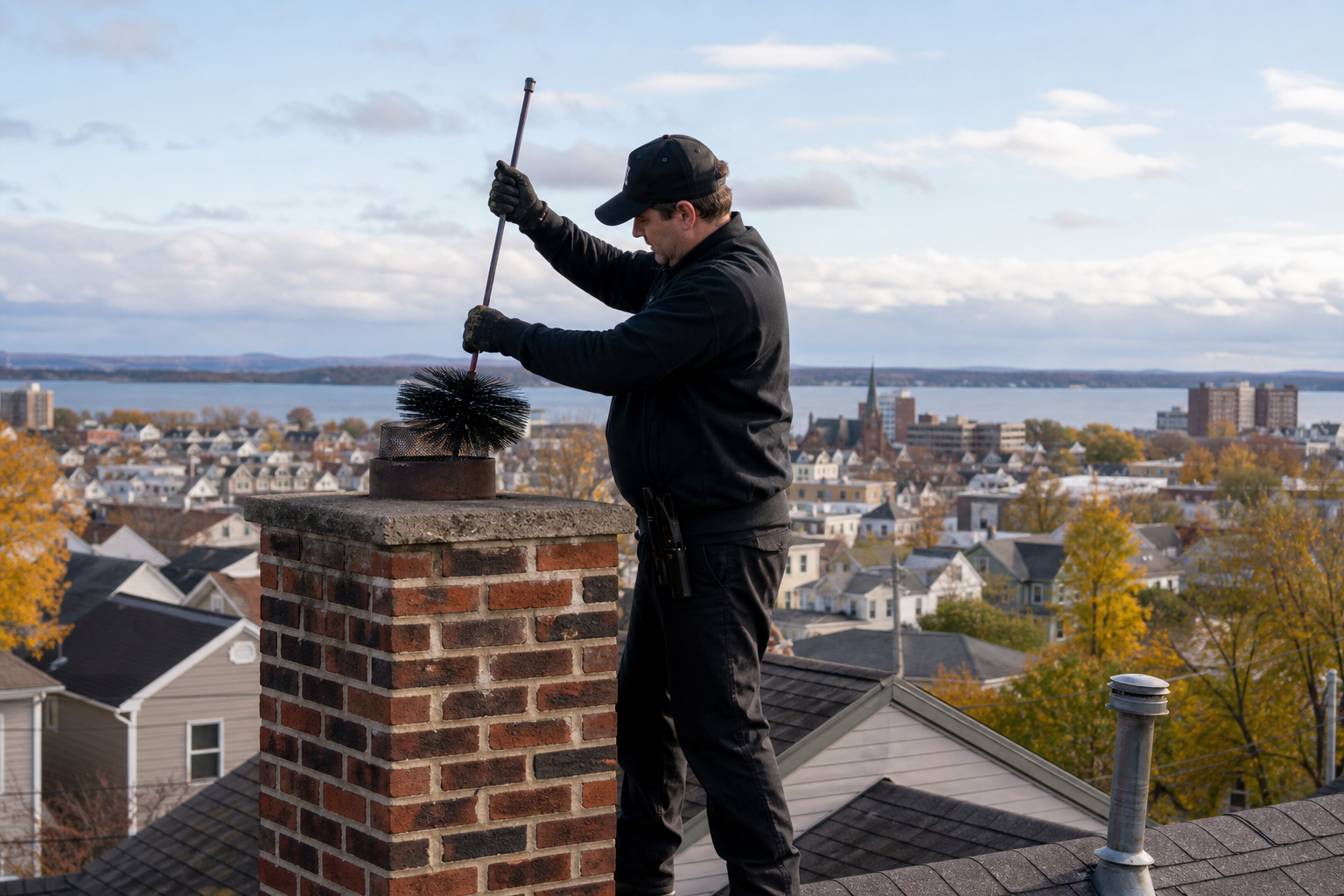
Emergency Chimney Cleaning & Sweep Near Me: What New Haven Homeowners Should Do First
If your chimney is actively smoking into your living room, making a freight-train roar, or refusing to draw at all, the first step is always: call the fire department if you suspect a chimney fire, then call a chimney specialist for same-day assessment. In New Haven, where winters are hard on masonry and many homes date to the 1920s–1950s, post-emergency inspections must check the liner, smoke chamber, and firebox before the fireplace is used again. If you’d rather not guess your way through an emergency, call Keystone Chimney Cleaning Greater New Haven at (888) 684-7419 — George shows up on every job, and we offer free estimates for post-incident work.
A chimney fire sounds like a freight train — a low roar, intense heat, and sometimes visible sparks from the top of the flue. Most homeowners who’ve never experienced one wait too long to call 911 because they think it’ll burn itself out. Some chimneys survive that. Many don’t. After 11 years in the chimney trade across New Haven, we’ve seen the aftermath: cracked flue liners, heat-damaged smoke chambers, and homeowners who made the emergency worse by closing the damper or opening the firebox door to “check.” The first 15 minutes of decisions matter more than the service call that follows.
What to Do Immediately If You Suspect a Chimney Fire
The correct order of actions isn’t intuitive — and getting it wrong can turn a containable event into a house fire.
Step one: Call 911. Do not wait to see if it burns out. Chimney fires can reach 2,000°F, and by the time you see flames from the top, the liner may already be compromised. The fire department in New Haven is equipped to handle chimney fires safely; they won’t judge you for calling.
Step two: Evacuate everyone from the home. Close interior doors behind you to slow smoke spread, but do not close the damper. This is the mistake we see most often. Closing the damper cuts off oxygen to the fire — which sounds logical — but it also traps superheated gases in a confined space, increasing pressure and forcing smoke and flames through any crack or gap in the masonry. The fire will find another way out, and that way is often into your walls.
Step three: Do not open the firebox door or stove door to “check.” Opening the door feeds oxygen directly to the fire. If you must do something while waiting for the fire department, spray a fire extinguisher at the firebox opening without opening the door, then step back.
Step four: Once the fire department clears the active emergency, do not use the fireplace again until a certified chimney technician inspects it. This is non-negotiable. We’ve inspected chimneys in New Haven neighborhoods like East Rock and Wooster Square where the homeowner lit a “small test fire” the next day and cracked the already-compromised liner completely through. The fire department’s job is to stop the fire. Ours is to determine if the system is safe to use again.
How to Tell a Partial Blockage From a Full Blockage — Without Making It Worse
Not every chimney emergency is a fire. Blockages from bird nests, collapsed liner sections, or heavy creosote buildup can back up deadly carbon monoxide into your home. The challenge is assessing the severity without opening the flue and releasing a faceful of smoke or debris.
Here’s what we check, in order, when a New Haven homeowner calls with blockage symptoms:
- Smoke behavior at startup: If smoke slowly fills the room when you light a small kindling fire, but the flue eventually draws, you likely have a partial blockage — creosote narrowing the passage, or a partial nest obstruction. This is urgent but not immediately life-threatening if you extinguish the fire.
- Immediate, total smoke backup: If lighting even newspaper sends smoke pouring into the room with zero draft, assume a full blockage. Do not continue trying to start the fire. The blockage could be a collapsed clay tile, a dead animal, or a complete nest — and the pressure of repeated lighting attempts can force toxic gases through any gap in the system.
- Smell test from the hearth: A sharp, ammonia-like smell suggests animal presence. A heavy, tarry smell suggests creosote buildup near the top. Both require professional cleaning before use.
- Visual check from the exterior — safely: From the ground, look for visible debris at the chimney cap, or a cap that’s missing or damaged. In New Haven, we’ve replaced dozens of Gelco caps after storms in the East Shore area knocked them loose. If you can see a nest or debris without climbing, report it to your technician. Do not climb the roof yourself.
The key distinction: partial blockages allow some airflow and give you warning symptoms. Full blockages create immediate, dangerous conditions. When in doubt, treat it as full and call for same-day service.
Smoke Rollback: What It Means and When It’s an Emergency
“Smoke rollback” is the term technicians use when exhaust reverses direction and enters the living space instead of exiting the flue. It’s not always a blockage — and understanding the three most common causes in New Haven homes helps you respond correctly.
Cause 1: Cold flue syndrome. In New Haven’s older homes, especially in winter, an uninsulated exterior chimney can hold a column of dense, cold air. When you light a fire, the rising hot smoke hits this cold plug and sinks back down. This is manageable: pre-warm the flue by burning rolled newspaper at the damper level for 60–90 seconds before lighting your main fire. If rollback persists after pre-warming, the issue is structural.
Cause 2: Negative pressure from modern HVAC and exhaust fans. Tight New Haven homes with new furnaces, range hoods, and bathroom fans can create negative pressure that overwhelms the chimney’s natural draft. This is an emergency when it happens during active burning — carbon monoxide can enter along with smoke. Open a nearby window slightly, turn off exhaust fans, and if the rollback continues, extinguish the fire and call for assessment.
Cause 3: Smoke chamber or flue design flaws. Many New Haven homes built before 1950 have parged smoke chambers that have deteriorated, creating turbulence that prevents smooth draft. Others have flues too small for the fireplace opening. These are chronic issues, not sudden emergencies, but they become dangerous if creosote buildup or damage narrows the passage further.
We’ve used HeatShield resurfacing in dozens of New Haven smoke chambers where the original parging had cracked and fallen away — it’s a professional-grade solution that restores smooth airflow without a full rebuild. But diagnosis comes first: smoke rollback from negative pressure requires different fixes than smoke rollback from a damaged smoke chamber.
What a Post-Emergency Inspection Must Cover Before You Burn Again
After a chimney fire, partial collapse, or severe smoke event, the fire department’s clearance does not mean your system is safe to use. Here’s what we check — and what you should ask any technician to confirm they’ve checked — before that first post-incident fire.
Flue liner integrity: We run a camera the full length of the flue. Clay tile liners often crack vertically after thermal shock; stainless steel liners can warp or separate at joints. In New Haven’s freeze-thaw climate, existing micro-cracks widen rapidly. We document every finding with video — no exceptions.
Smoke chamber condition: The smoke chamber — the area above the damper and below the flue — takes the brunt of chimney fire temperatures. We check for spalling brick, missing mortar, and cracked parging. This is where HeatShield resurfacing or full rebuild decisions get made.
Firebox and hearth structural soundness: Cracked firebrick or shifted hearthstones indicate heat penetration that compromised the thermal barrier. We also check the fireplace surround and mantel for heat discoloration — a telltale sign that gases escaped the firebox.
Clearance to combustibles: In older New Haven homes, framing sometimes sits closer to the chimney than modern code allows. A chimney fire can char hidden wood even if the exterior looks fine. We use inspection cameras and, when necessary, remove small sections of interior finish to verify.
We pulled one out of a garage over in Fair Haven last month where the homeowner had a “small chimney fire” in January, got the all-clear from the fire department, and burned all February without inspection. By March, the heat-damaged liner had cracked completely through, and exhaust was leaking into the wall cavity. The repair required a full liner replacement with Olympia Chimney stainless steel and refractory work in the smoke chamber — work that would’ve been half the scope if caught immediately after the fire.
Finding Same-Day or Next-Day Assessment in Greater New Haven
Not every chimney company can handle post-emergency work. Many routine sweep operations lack the inspection equipment or repair capability to properly assess fire damage. Here’s what to ask when you call:
- “Do you run video inspection on every post-fire assessment?” If they don’t, they can’t see what matters.
- “Can you handle liner replacement and smoke chamber repair, or do you subcontract?” Subcontracting means handoffs, delays, and blurred accountability. George shows up on every job — the person who quotes your repair is the person doing it.
- “What brands do you use for liner and refractory work?” Unbranded catalog materials fail faster. We use professional-grade products: DuraFlex for flexible liners, HeatShield for smoke chamber resurfacing, Gelco and Famco for caps and components. Ask for specifics.
- “What’s your actual availability?” “We’ll get you on the schedule” isn’t an answer. We offer same-day or next-day post-emergency assessments throughout Greater New Haven because we know an unusable fireplace in January isn’t a minor inconvenience.
412 homeowners have trusted us with their chimney systems over 11 years focused on chimneys — not gutters, not roofing, not general handyman work. That focus matters when you’re diagnosing whether a fire-compromised liner can be repaired or must be replaced.
When to call a pro: If you’ve had any smoke event, fire event, or sudden draft failure, do not use the fireplace again until it’s inspected. The risk isn’t just another smoky room — it’s carbon monoxide exposure or a second, more destructive fire.
Related services in New Haven: For routine maintenance before emergencies develop, see our Chimney Cleaning & Sweep in West Haven page. For masonry and structural repairs, visit Chimney Repair in West Haven. For gas fireplace and insert work, our Fireplace Services in West Haven team handles conversions, repairs, and installations.
The Bottom Line
Chimney emergencies in New Haven demand a specific sequence: fire department first if there’s active fire or uncontrolled smoke, then a specialist inspection before any reuse. The most dangerous mistake is assuming the emergency ends when the visible symptoms stop — cracked liners, damaged smoke chambers, and compromised clearances don’t announce themselves until the next fire makes them catastrophic.
Key takeaways:
- Never close the damper during a suspected chimney fire — it forces gases into wall cavities.
- Treat full blockages as immediate hazards; partial blockages still require same-day professional attention.
- Smoke rollback has three distinct causes in New Haven homes — only one is solved by “opening a window.”
- Post-emergency inspections must cover liner, smoke chamber, firebox, and clearance to combustibles with video documentation.
- Verify your technician can perform repairs, not just sweeps, and uses named professional-grade materials.
If you’re in New Haven and facing a chimney emergency — or recovering from one — Keystone Chimney Cleaning Greater New Haven offers free estimates and same-day or next-day assessment. George Nguyen personally leads every inspection and repair. Call (888) 684-7419 to schedule.
Frequently Asked Questions
Emergency chimney cleaning and post-incident inspection in New Haven typically ranges from $250–$450 for the assessment and sweep, with repairs such as liner replacement or smoke chamber resurfacing running $1,200–$4,500 depending on scope. The exact cost depends on flue length, accessibility, and whether video inspection reveals damage requiring immediate repair. Call (888) 684-7419 for a free estimate — we’ll assess on-site and quote before any work begins.
Yes — we offer same-day or next-day post-emergency assessments throughout Greater New Haven, including evenings and weekends during heating season. We prioritize active fire events, carbon monoxide concerns, and total draft failures. Call (888) 684-7419 and we’ll give you a realistic arrival time based on current demand.
Repair is cheaper only if the damage is localized and the liner material supports it — typically small cracks in stainless steel that can be sealed, or isolated clay tile fractures in otherwise sound systems. After a chimney fire, most clay tile liners require full replacement because thermal shock creates hidden vertical cracks that reopen under heat. We run video inspection to determine repairability before quoting either option. Call (888) 684-7419 for a free assessment.
Signs of smoke chamber damage include visible spalling or missing mortar when viewed from the firebox, a strong smoke smell that persists after cleaning, and poor draft despite a clear flue. However, much of the smoke chamber is not visible without specialized inspection equipment. After any chimney fire, we camera-inspect the smoke chamber as part of our standard post-incident protocol — no exceptions. Call (888) 684-7419 to schedule this critical check before using your fireplace again.
Written by George Nguyen, Owner & Lead Technician at Keystone Chimney Cleaning Greater New Haven, serving New Haven since 2015.
Need Chimney Cleaning Help?
Call Keystone Chimney Cleaning Greater New Haven — licensed & insured, here with fast after-hours help in New Haven.
(888) 684-7419