
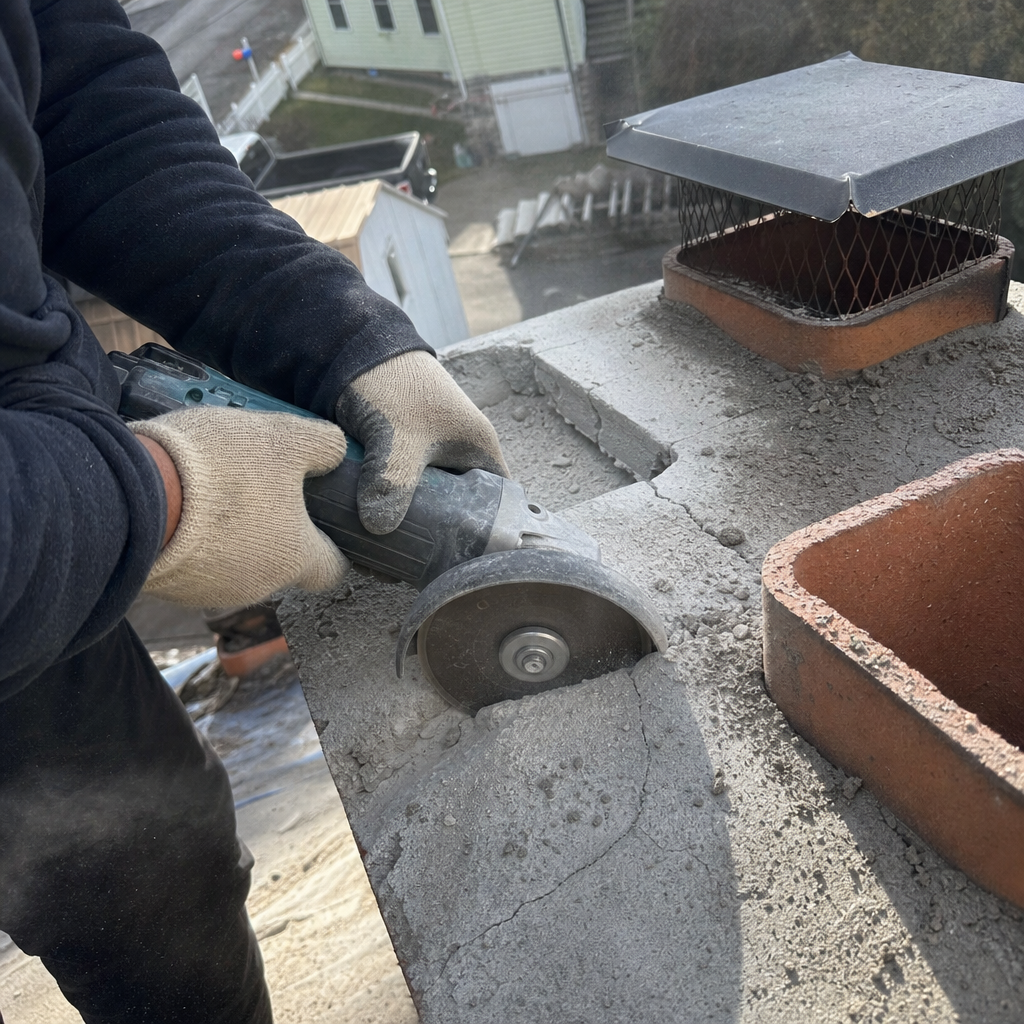
Chimney Flashing Repair in New Haven, CT: Why Nor’easter Wind-Driven Rain Demands a Chimney Specialist, Not Just a Roofer
Chimney flashing repair in New Haven typically costs $450–$1,200 depending on whether you’re addressing step-flashing replacement, counter-flashing reseating, or both systems together. Most jobs we complete in the city are done within a single day, and George Nguyen, our Owner & Lead Technician, handles the diagnostic himself — call (888) 684-7419 for a free estimate with same-week scheduling.
Most chimney leaks that show up after a nor’easter aren’t a roofing problem — they’re a flashing lap problem. Wind-driven rain moves horizontally, and horizontal rain finds the exact spot where your step-flashing and counter-flashing don’t overlap tight enough. We’ve spent eleven years tracing these leaks across New Haven’s old housing stock, and the pattern is consistent: the water stain on your ceiling near the chimney almost never means you need new shingles. It means the two-part flashing system designed to bridge your roof plane and your brick chimney has failed at the seam — and a roofer who only knows shingles often misses the counter-flashing detail that’s actually letting the water in.
How New Haven’s Coastal Storms Break Flashing That Works Fine in Calm Rain
New Haven sits directly on Long Island Sound, and that geography matters for your chimney. Nor’easters tracking up the coast don’t drop rain straight down — they drive it sideways at 40, 50, sometimes 70 miles per hour. That wind-driven rain exploits gaps in flashing that a standard vertical water test would never find.
Here’s what happens on your roof during a typical March or October storm. The step flashing — those L-shaped metal pieces woven between your shingles and bent up against the chimney — is designed to shed water running down the roof plane. But when rain hits horizontally, it can penetrate behind the vertical leg of the step flashing if the counter-flashing isn’t doing its job. The counter-flashing is the metal cap embedded into your chimney’s mortar joints, folded down over the step flashing to create a protected overlap. Without that overlap sealed tight, wind-driven rain goes straight into the gap, runs down the chimney face, and shows up as a stain on your ceiling drywall — sometimes feet away from where the actual leak originates.
In eleven years of chimney work across Greater New Haven, we’ve learned to diagnose from both sides. George checks the smoke chamber and firebox for moisture staining that tells him whether water is entering high on the chimney or lower down. Then he examines the exterior step-flashing alignment and counter-flashing embedment. A roofer standing on the shingles sees only half the system. We see the whole path the water takes — and we fix it at the source, not the symptom.
Step Flashing vs. Counter-Flashing: Why Repairing One Without the Other Fails
The most common flashing mistake we see in New Haven — usually after a homeowner has already paid someone else — is replacing step flashing while leaving degraded counter-flashing in place. The two components work as a system, and they fail for different reasons.
Step flashing weaves with your shingles, piece by piece, each step bending up against the chimney. It fails when:
- Shingle replacement disturbs the weave pattern, leaving gaps
- Corrosion eats through galvanized steel (common after 15–20 years)
- Improper nailing allows the metal to pull away from the chimney face
Counter-flashing is cut into your mortar joints, folded down to cover the step flashing’s vertical leg. It fails when:
- Mortar joints spall or soften, loosening the metal embedment
- Lead counter-flashing on pre-1920 chimneys compresses and cracks after a century of thermal cycling
- Previous “repairs” slathered caulk over gaps instead of reseating the metal properly
On New Haven’s pre-1920 brick chimneys — common in Fair Haven, Dwight, and the Hill — original counter-flashing was often lead-embedded into mortar joints. That lead has softened and compressed over a century. Caulking over it buys you a season, maybe two, before the thermal expansion of freeze-thaw cycling opens the gap again. The proper repair is reseating or replacing the counter-flashing with new lead or copper, cut into sound mortar and folded correctly over the step flashing below.
We’ve worked with Olympia Chimney and Famco flashing components for years because their gauge and bend profiles match the original work on New England masonry chimneys. When we specify materials, we’re not grabbing catalog substitutes — we’re matching the system that was designed to last.
What Chimney Flashing Repair Costs in New Haven
Pricing depends on how much of the two-part system needs attention, the height and access of your chimney, and whether your mortar joints are sound enough to accept new counter-flashing embedment. Here’s what we typically see in the New Haven market:
| Repair Scope | Price Range |
|---|---|
| Counter-flashing reseal/reseat (existing metal sound, mortar repair only) | $450–$650 |
| Counter-flashing replacement with new lead or copper, mortar cutting | $700–$950 |
| Step flashing replacement (partial, one roof plane) | $550–$800 |
| Complete step + counter-flashing system replacement | $900–$1,200 |
| Mortar joint repointing required for counter-flashing embedment (add-on) | $200–$400 |
We don’t quote by phone without seeing the chimney. Access, roof pitch, and the condition of surrounding masonry all affect the actual scope — and we’d rather give you an accurate number after a ten-minute inspection than a lowball that changes once we’re on your roof. Estimates are free. Call (888) 684-7419 to schedule.
Common Local Scenarios: Flashing Failures We See in New Haven Neighborhoods
Every neighborhood in New Haven presents a slightly different flashing problem based on housing age, chimney configuration, and exposure to the Sound. Here are the patterns we’ve documented over eleven years:
Fair Haven triple-deckers. These converted multi-family homes often share a single chimney stack with two to four flues. A landlord who patches one tenant’s ceiling stain without inspecting the full flashing system leaves the other units exposed — and creates liability if carbon monoxide or moisture intrusion affects the shared structure. George grew up in Fair Haven and still lives ten minutes from the house he was raised in; he knows these buildings from the inside out.
East Rock and Wooster Square historic districts. Any repointing or liner work on a chimney visible from the street can trigger design-review scrutiny under local historic preservation guidelines. We’ve learned to flag this before quoting repair work, so homeowners don’t face costly surprises after the job is scoped. It’s a detail that rarely comes up in non-historic neighboring towns like Hamden or West Haven.
Pre-1920 brick rowhouses in Dwight and the Hill. Original coal-era chimneys were never lined for modern gas or wood appliances, and the thermal shock of conversion accelerates mortar degradation. Counter-flashing embedded in spalling mortar can’t be reseated without first repointing — a step that adds cost but prevents the same leak from recurring in eighteen months.
Coastal exposure near Lighthouse Point and Morris Cove. These properties take the full brunt of Sound-driven nor’easters. We’ve seen wind-driven rain penetrate flashing systems that tested watertight in calm conditions. Our diagnostic protocol includes simulating horizontal water exposure where the chimney geometry suggests risk — not just running a hose straight down.
Why a Chimney Specialist Should Coordinate With Your Roofer
When shingles need replacement around the chimney, a roofer working without a chimney technician present often laps the step flashing wrong — missing the critical overlap with counter-flashing, or driving nails through the metal where they shouldn’t. We’ve been called in after these jobs to fix leaks that “shouldn’t” exist because the new shingles look perfect.
Keystone handles this differently. George coordinates directly with roofing contractors when both trades are needed, specifying the step-flashing weave pattern and ensuring counter-flashing is protected during shingle removal. We’re not competing with your roofer — we’re making sure the chimney side of the work is done by someone who understands how the two systems interact. Chimney repair is what we do; we don’t install shingles, and we don’t pretend to. But we know exactly how flashing should integrate with them.
Our home page outlines our full service range, from annual sweeps to complete liner rebuilds. Flashing repair is one piece of that lifecycle — and it’s the piece that prevents the water damage that leads to bigger problems.
George’s Diagnostic Process: What Happens When We Arrive
When you call (888) 684-7419, George schedules the inspection himself. Here’s what that looks like:
- Interior first. We examine the firebox, smoke chamber, and accessible flue for moisture staining pattern — high stains suggest crown or cap failure; mid-level stains point to flashing; base staining can indicate foundation moisture wicking.
- Roof and chimney exterior. We photograph step-flashing alignment, counter-flashing embedment depth, mortar joint condition, and crown integrity.
- Flashing overlap test. Where safe and appropriate, we probe the counter-flashing/step-flashing seam to confirm overlap depth and seal condition — without dislodging anything.
- Written scope with photo documentation. You get a clear explanation of what’s failed, why it failed, and exactly what we propose to fix it — with line-item pricing.
412 homeowners have trusted us with their chimneys across Greater New Haven, and that number matters because it reflects a consistent, repeatable process — not a handful of cherry-picked testimonials. Our 4.7-star average tells you the process works; the volume tells you it works reliably.
George’s standard is straightforward: “If I wouldn’t light a fire in it tonight, I’ll tell you exactly why before I leave the driveway.” That means no soft-pedaling a flashing gap that puts your framing at risk, and no upselling a full rebuild when a targeted counter-flashing reseat solves the problem.
FAQs
Most chimney flashing repairs in New Haven run $450–$1,200, with simple counter-flashing reseals at the lower end and complete step-plus-counter system replacements at the higher end. We provide exact quotes after a free on-site inspection — call (888) 684-7419 to schedule.
Repair is cheaper when the existing metal is sound and only the mortar embedment or seal has failed; replacement becomes necessary when step flashing is corroded, counter-flashing is cracked, or mortar joints are too degraded to hold new embedment. We always recommend the least invasive fix that will last — but we won’t caulk over failing metal and call it good. For an honest assessment of your specific chimney, call (888) 684-7419 for a free estimate.
We can complete most straightforward counter-flashing reseals and small step-flashing repairs same-day if the weather permits safe roof work and we have the appropriate materials on the truck; larger replacements requiring custom-fabricated lead or copper typically schedule within a week. Call (888) 684-7419 — we’ll let you know what’s realistic for your chimney before we make the trip.
Wind-driven rain from coastal storms hits your chimney horizontally at pressures that standard vertical rain never produces, forcing water behind counter-flashing that appears sealed in calm conditions and exploiting step-flashing gaps that vertical runoff would miss. This is especially common in New Haven’s harbor-exposed neighborhoods where storms track directly up Long Island Sound — and it’s why we inspect for horizontal water intrusion, not just vertical drainage. If you’re seeing this pattern, call (888) 684-7419 before the next storm makes it worse.
Get a Free Estimate for Chimney Flashing Repair in New Haven
Wind-driven rain from Long Island Sound nor’easters doesn’t give your flashing a second chance — and neither should you. George Nguyen, Owner & Lead Technician at Keystone Chimney Cleaning Greater New Haven, handles every flashing diagnostic personally, with eleven years of chimney-only experience and professional-grade materials from trusted brands. Call (888) 684-7419 today for a free, no-obligation estimate with same-week scheduling available.
Written by George Nguyen, Owner & Lead Technician at Keystone Chimney Cleaning Greater New Haven, serving New Haven, CT.